Introduction
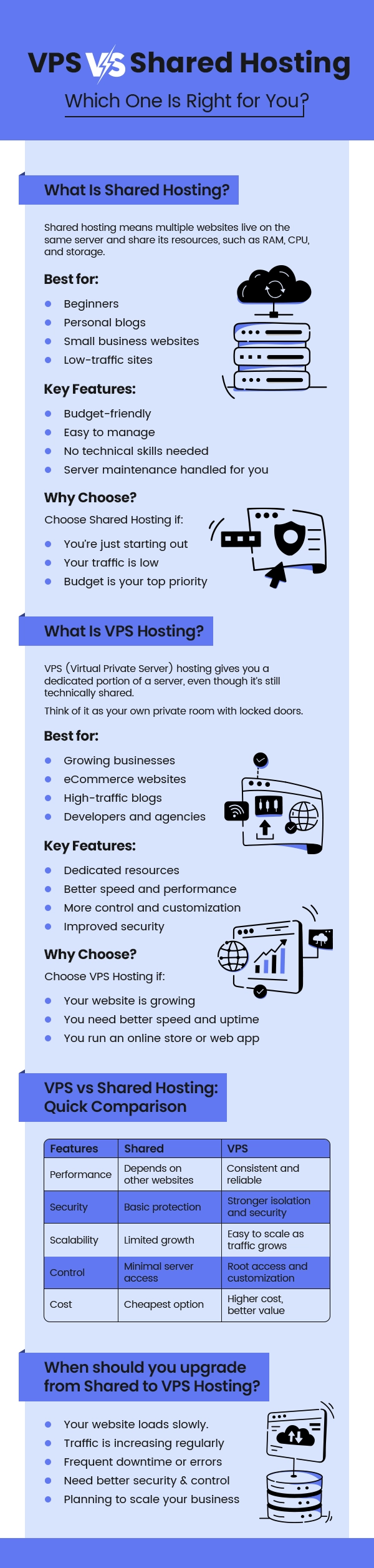
Choosing between VPS Hosting and Shared Hosting can feel confusing, especially when both promise speed, security, and performance. One sounds budget-friendly, the other sounds powerful… but which one actually fits your business?
Whether you’re launching a new website, running a growing business, or are tired of slow load times, understanding the fundamental difference matters. This infographic breaks down VPS vs Shared Hosting in the simplest way possible – no tech jargon, no overthinking.
Just clear comparisons to help you decide what works best for your website today (and tomorrow).
Scroll down, and let’s make hosting choices less confusing and more confident!
Also Read: Is Free Web Hosting Still Worth It Today?
Conclusion
Shared hosting is perfect for starting small. VPS hosting is ideal for scaling smart.
Shared hosting is perfect for starting small. VPS hosting is ideal for scaling smart.
If your website feels slow, crashes during traffic spikes, or needs more control, it’s probably time to upgrade.
Start with shared hosting. Move to VPS when your website demands more power.

Your application deserves precision perfect hosting
Frequently Asked Questions
No. VPS (Virtual Private Server) is a type of hosting. Hosting is a broad term that encompasses shared, VPS, dedicated, and cloud hosting. VPS gives you dedicated resources on a shared server, while shared hosting allocates resources to many users.
Yes, in most cases. VPS hosting is faster because your website gets dedicated resources like CPU, RAM, and storage. In shared hosting, heavy traffic on another website can slow down your website.
Not exactly. Most VPS plans come with high bandwidth limits, but truly unlimited internet is rare. Always check the bandwidth or data transfer limits mentioned in the plan.
Choosing between a VPS or Dedicated server depends on your needs.
- VPS is best for growing websites that need performance and flexibility.
- Dedicated servers are ideal for very high-traffic websites, large applications, or advanced security needs. VPS is more cost-effective, while dedicated servers offer full control.
Yes, especially for growing websites. VPS offers better performance, security, scalability, and control than shared hosting. Shared hosting is cheaper, but performance is limited.
Shared hosting is best when:
- You’re launching a new website
- Your traffic is low
- You want a budget-friendly option
- You don’t need advanced server control
Yes. You can host multiple websites on a single server as long as your VPS’s resources (RAM, CPU, storage) can handle the traffic and usage.
For migrating your website, the basic steps include:
- Set up your VPS server
- Move website files and databases
- Update configuration files
- Test the website on VPS
- Update DNS to point to the VPS. Many hosting providers also offer free or assisted migration.
You should consider switching when:
- Your website is slow
- Traffic is increasing
- You face frequent downtime
- You need better security or customization
- Your hosting limits are holding you back
There’s no fixed number. You can host as many websites as your VPS resources allow. The limit depends on website size, traffic, and server configuration.
Not really. Shared hosting can work for SEO on small websites, but performance issues such as slow speeds or downtime can negatively affect rankings. VPS hosting usually provides better stability and speed, which supports SEO growth.

![Web Hosting Guide for Beginners [Infographic]](https://www.hostitsmart.com/blog/wp-content/uploads/2018/12/image1.jpg "Web Hosting Guide for Beginners [Infographic]")
![How to Buy a Domain Name?[Infographic]](https://www.hostitsmart.com/blog/wp-content/uploads/2019/09/How-to-Buy-a-Domain-Name.jpg "How to Buy a Domain Name?[Infographic]")

