| Getting your Trinity Audio player ready... |
Highlights
- ChatGPT can help you build a website. But it cannot fully create and launch one on its own.
- It works best as a support tool for coding, content creation, planning, and debugging. Not a full website builder.
- Many people overestimate its abilities. They assume it can replace developers or build complete websites in one prompt.
- AI website builders go further than ChatGPT. They offer drag-and-drop design, web creation, hosting, and publishing tools.
- The reality is that AI is improving web development. It’s not replacing developers, as they are still essential for real-world systems.
Introduction
Can ChatGPT build a website? It’s a question a lot of people are asking right now. And the answers can be confusing.
Some say you can create a full website with just one prompt. Others say it’s not even close to replacing real development.
So what’s the truth? Yes, you can use ChatGPT to build a website. BUT not in the way most people expect.
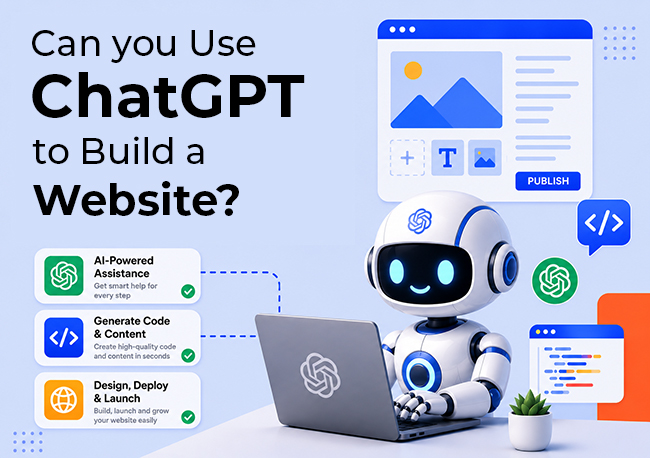
It won’t magically create and launch a complete site for you. What it can do is help you write code, design your pages, create content, and fix problems along the way.
Think of it less as a website builder. And more as a smart assistant that helps you build faster.
On this page, we’ll answer whether ChatGPT can build a website. Specifically, we’ll cover the following:
- What people think ChatGPT can do
- What it can actually do in website building
- Where it falls short
- When it becomes genuinely useful
- Whether it can replace developers or website builders
Read on…
Also Read: Know About Web Development Industry Statistics
Can You Use ChatGPT To Build a Website?
Yes. You can use ChatGPT to build a website. However, it depends on what you mean by “build.”
If you mean:
- Generating HTML, CSS, or JavaScript
- Creating a website’s landing page content
- Structuring website pages
- Suggesting design layouts
- Helping debug code
Then yes, ChatGPT is extremely useful.
But if you mean:
- Automatically hosting your website
- Connecting domains
- Deploying to production
- Handling databases, frontend & backend systems, and scaling
Then no, ChatGPT cannot do that on its own.
So the more accurate answer is:
ChatGPT can help you build a website, but it doesn’t fully build and run one for you.
Why not?
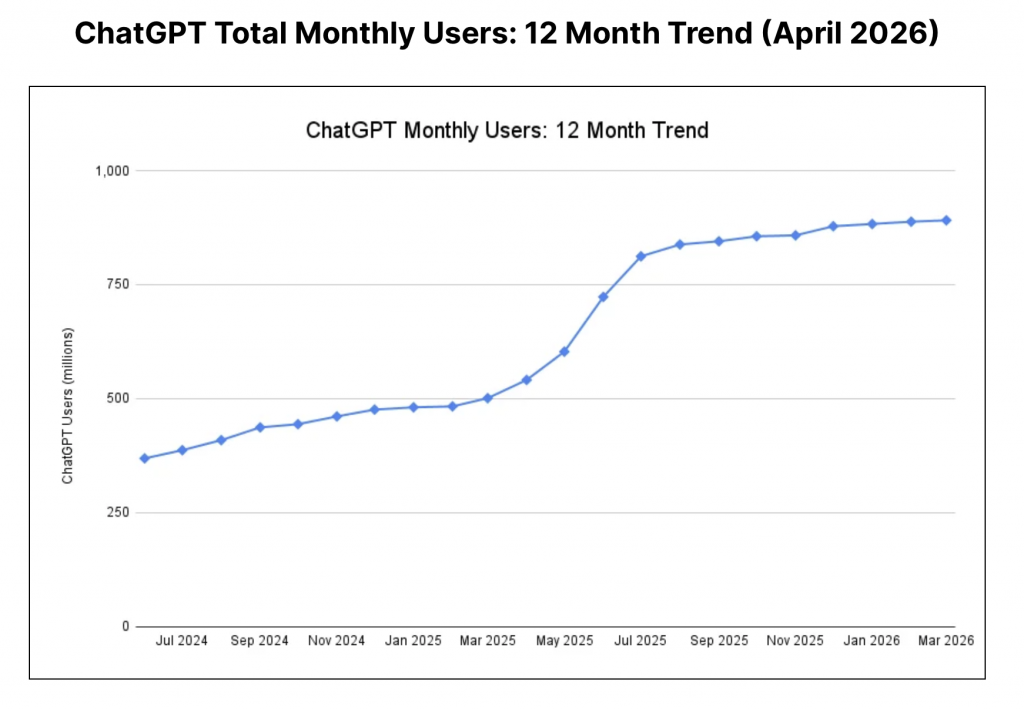
ChatGPT has established itself as a top AI tool worldwide. With nearly 900 million monthly active users (MAU). So, make the most of using this platform, particularly for creating sites. Not as a website builder, but as a helping tool!
Also Read: How to Write Website Content Using ChatGPT?
What People Think ChatGPT Can Do?
When people first hear “you can build a website with ChatGPT,” expectations tend to go a little too far. Here’s what many assume (expectations vs. reality):
| Expectations | Reality |
| One prompt builds a full website | ChatGPT can write code and content, but you still need to build, host, and launch the website yourself. |
| No coding or setup needed | You still need a platform, hosting, and basic setup to make the site live. |
| ChatGPT replaces developers | It helps developers work faster, but it doesn’t replace them. |
| Everything is handled automatically (design, content, SEO) | ChatGPT can help, but you still need to guide and refine it. |
| It understands my business right away | It only knows what you tell it. |
| The code always works perfectly | It’s useful, but you may still need to fix bugs. |
| It can publish my website online | It can’t host or deploy sites. |
| It can fully build complex apps like eCommerce or SaaS | It can help with parts, but not full systems on its own. |
| AI websites automatically perform well | Performance still depends on setup and optimization. |
| It works like a website builder | It’s an assistant, not a builder. |
Learn from Bryan Henry, President of PeterMD. He emphasizes that in a healthcare-driven business like theirs, AI tools can support website creation. However, he cites that accuracy and compliance still require human oversight and proper systems.
Take a look at their website (have a glimpse below). ChatGPT can help with things like creating FAQs, writing content, suggesting layouts, and generating basic code. But developers still need to handle network security, tech integrations, regulatory compliance, and website performance. AI helps speed up the process, but it doesn’t replace real development work.
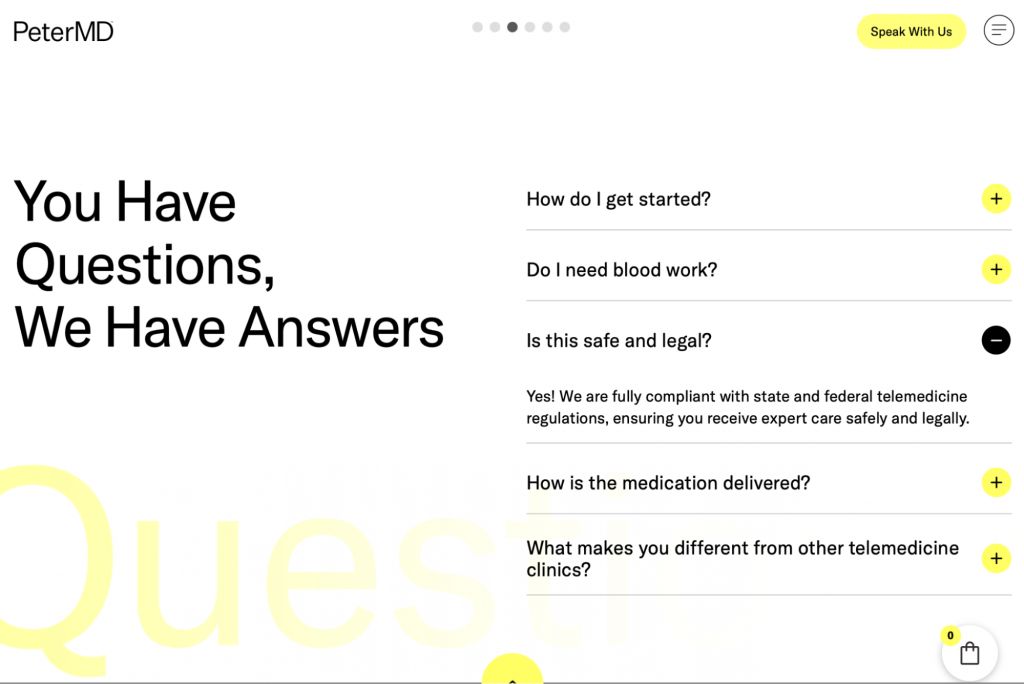
Henry says, “ChatGPT is incredibly useful for speeding up parts of the website process..like generating content or drafting code. But it doesn’t replace the strategy and systems required to launch something real. In our experience, it works best as a tool alongside experienced teams…not instead of them.”
Also Read: Is Web Development Dying in the Future?
What ChatGPT Can Actually Do?
A lot of confusion around ChatGPT comes from expecting it to build entire websites end-to-end. But when you strip away the hype, what it actually does is still very powerful.
It just works as a support tool. Not a standalone website builder. Here’s what it’s genuinely good at:
| ChatGPT Functions | What It Actually Does |
| Code generation (frontend + basic backend) | This is one of ChatGPT’s strongest use cases. You can use it to generate:
“Create a responsive landing page for a digital marketing agency” …rather than writing a landing page from scratch. And it can produce a working starting point. But the key here is: It gives you usable building blocks, not a finished production system. |
| Content creation (for websites) | ChatGPT is extremely useful for filling your website with content. It can help you write:
Instead of staring at a blank page, you get structured, readable, SEO-friendly draft content instantly |
| Website planning | Before you even touch code, ChatGPT can help you think clearly. It can generate:
“Plan a website structure for a SaaS project management tool” It will map out pages like:
|
| Helping with CMS (WordPress, Webflow, etc.) | ChatGPT can also guide you when using website builders and CMS tools. It can help with:
|
Also Read: Know the Difference Between CSS and CSS3
Where ChatGPT Fails?
ChatGPT is powerful, but it has clear limits when it comes to building real websites. Sure, it can assist in the process. However, there are areas where it simply cannot replace real tools and/or systems. Even developers.
Here are areas where it can fail:
➜ Website deployment and hosting: ChatGPT cannot publish and/or host a website for you. It can generate code, but you still need platforms like WordPress to make it live. Deployment is a separate technical process that requires manual setup.
➜ Full-scale system architecture: Complex websites like SaaS platforms need proper architecture design. ChatGPT can suggest ideas, but it cannot reliably design scalable databases and/or backend systems. These require real engineering decisions based on long-term performance.
➜ Security and production readiness: ChatGPT-generated code is not automatically production-ready. It may miss key website security practices, such as authentication hardening and data protection. These must be reviewed and implemented by developers.
➜ Real-world testing and performance validation: ChatGPT cannot test how a website performs under real user conditions. For instance, it doesn’t simulate device differences or network issues. This means issues like slow load times and broken layouts can still appear in real usage.
➜ Understanding full business context: ChatGPT only works based on prompts, not deep business understanding. It doesn’t truly know your customers, market positioning, industry trends, and/or conversion goals. Because of this, its output often needs refinement to match real business needs.
For example:
If you’re trying to build an eCommerce website to sell design hoodies (like the one below), ChatGPT can help generate product descriptions. It can assist you in layout ideas. It can even help with basic coding.
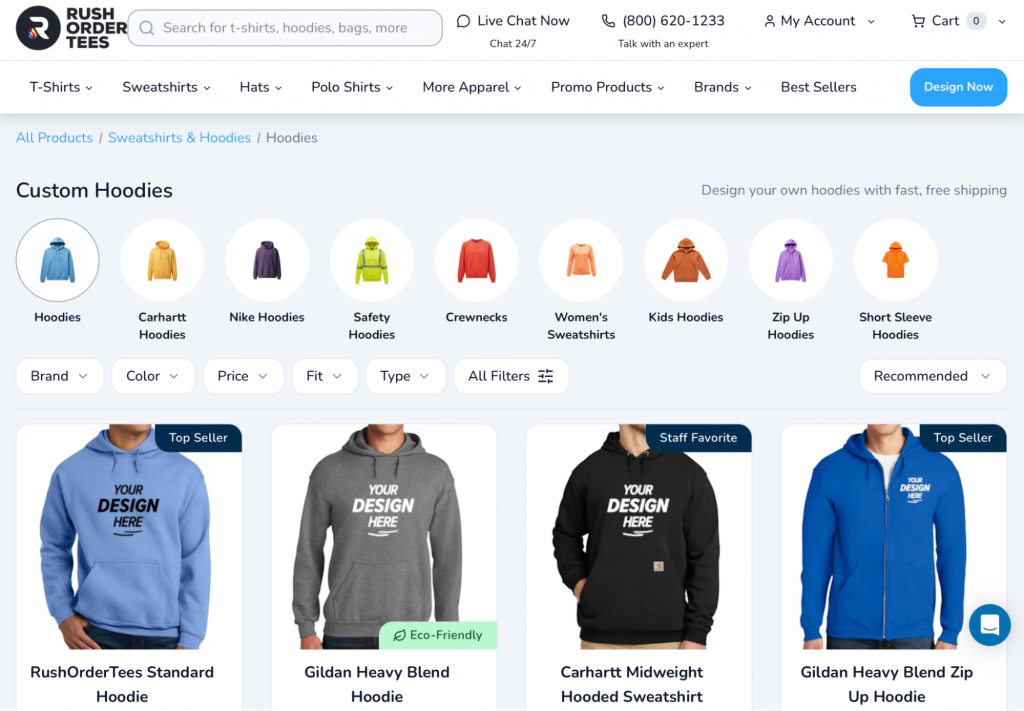
However, it can’t fully set up payments and manage inventory systems. Or ensure the site runs smoothly under real customer traffic.
Still, you’ll need web developers and proper tools to turn it into an operational online store.
Also Read: Biggest Security Threats to Websites
ChatGPT vs AI Website Builders vs Developers
Can I build a website? Or can you build a website with ChatGPT? Or do we need to hire a web developer?
When it comes to website building with ChatGPT:
You’re no longer limited to just hiring a developer. You also have AI tools and website builders that can handle parts of the process for you.
But each option works very differently. Some are great for ideas and content, others for fast website creation. And some for full-scale, custom development.
To understand which one fits your needs, it helps to compare them side by side.
| Category | ChatGPT | AI Website Builders | Developers |
| Primary Role | Assistant for ideas, content, and code generation | End-to-end website creation with templates and AI tools | Full custom website and system development |
| Ease of Use | Easy, prompt-based | Very easy, drag-and-drop + AI setup | Requires technical expertise |
| Website Creation | Generates code and structure only | Builds and publishes websites | Builds everything from scratch |
| Customization | Limited, depends on prompts | Moderate, template-based flexibility | Very high, fully custom |
| Hosting & Deployment | Not included | Included in most platforms | Manually configured or managed |
| Best For | Content, prototypes, debugging, planning | Small businesses, portfolios, quick websites | Complex, scalable, or enterprise systems |
| Scalability | Limited without technical setup | Moderate | Very high |
Also Read: Which Technology is Best For Website Development?
If Not ChatGPT, Can Other AI Tools Build a Website Better?
ChatGPT is great for planning, writing, creating visuals, and generating code. But it still isn’t a full website builder. That’s where AI-powered website builders come in.
These tools go a step further. They don’t just generate ideas or code. They actually help you design and build websites faster. Often, with drag-and-drop systems and built-in hosting.
That said, they still don’t replace strategy or human decision-making. But compared to ChatGPT alone, they offer a more complete “website-building experience.”
Here are some of the most popular AI-powered tools used for website creation:
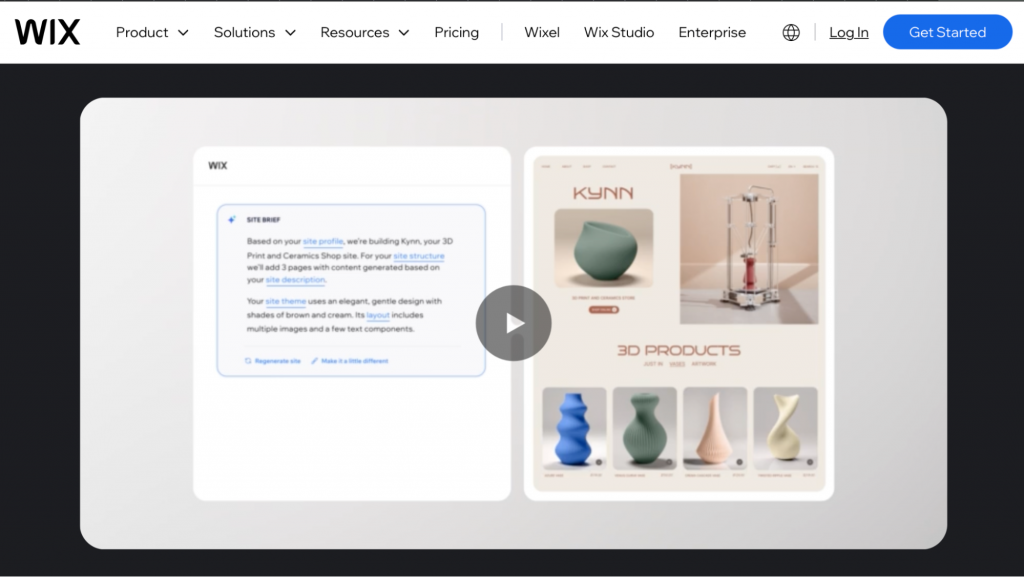
➜ Wix ADI: AI-generated websites based on simple questions; includes layouts, content, and built-in hosting.
➜ Framer AI: Prompt-based website creation with modern responsive designs and visual editing tools.
➜ Durable AI: Instant small business websites with auto-generated pages, copy, and branding in under a minute.
➜ Zoho Creator: AI-powered app and website builder for custom business tools, workflows, and systems.
Also Read: Do Websites Go Away with AI Agents
What’s the Reality: Is AI Replacing Web Developers?
The reality is: AI is not replacing web developers; It’s changing how they work.
According to Precedence Research:
The global AI market could grow from $900.00 billion in 2026 to about 4.2s trillion by 2035. Expanding at an 18.73% compound annual growth rate (CAGR).

As far as web development is concerned, AI tools for web developers can speed up planning, coding, testing, debugging, and documentation. They can help developers generate layouts, write boilerplate code, improve SEO structures, and even troubleshoot errors faster than before.
However, AI still requires human oversight, especially for complex systems where accuracy, security, and reliability matter.
Cases in point:
➜ Contract management software Contract management software systems need secure document handling, permission controls, workflow automation, audit trails, and compliance safeguards. These are not systems you can fully trust AI to build and manage on its own.
➜ Healthcare websites: Healthcare websites need more than AI-generated code. AI can help build appointment forms and patient portals. However, developers still need to secure medical records, protect patient privacy, and ensure the system follows healthcare regulations.
➜ Fintech platforms: Fintech platforms are another example. AI can speed up coding and design tasks. But developers are still responsible for transaction security, fraud prevention, encryption, and overall system reliability.
In these cases, developers are still responsible for system architecture, performance optimization, integrations, security, and long-term scalability.
Sure, AI can assist with development. However, it cannot independently make business-critical decisions. It cannot fully understand the real-world risks involved in production systems.
In short, AI is making developers faster and more efficient. Not obsolete!
Also Read: Is Making a Website Hard – Know the Truth
Final Verdict
So, let’s go back to the original question: can ChatGPT build a website? Yes. But only up to a point.
You can use ChatGPT to:
- Generate code
- Write website content
- Plan structure and layout
- Fix and improve what you build
But it can’t:
- Launch your website
- Manage hosting or servers
- Fully replace developers or website builders
The real value of ChatGPT is not in replacing the process. It’s speeding it up.
Used the right way, ChatGPT becomes a powerful tool that helps you build websites faster and smarter. But you still need the right tools and setup, sometimes real development work, to bring everything together.