Introduction
You’ve probably noticed the abundance of .COM websites out there, and it makes you wonder, is it just tradition, or does a .COM actually give you an edge in Google rankings?
Well, search engines like Google insist that domain extensions don’t directly boost rankings, but the reality is that user trust, click-through rates, and even brand perception often lean heavily toward .COM domains.
With over 150 million .COM domains registered worldwide, could this subtle preference be indirectly shaping your website’s SEO success?
In this blog, we’re going to unravel the mystery behind .COM domains, explore what the data says, and whether choosing the .COM domain could give your site an unseen advantage or not.
Highlights
- .COM doesn’t boost rankings by itself; search engines treat all domain extensions equally. What matters is your website’s content and performance.
- Core ranking factors in 2026 include content quality, E-E-A-T, user intent alignment, backlinks, and strong technical SEO.
- .COM domains still hold trust value, offering familiarity, credibility, and better click-through rates among users.
Understanding Domain Extensions (TLDs)
Before hopping onto whether .COM domains rank higher or not, it’s important to understand what domain extensions or TLDs (top-level domains) are. Simply put, a TLD is the suffix at the end of your website address: think .COM, .net, .org, or newer options like .tech, .store, and .design.
At first glance, it might seem like a tiny detail, but in the world of websites, it can send subtle signals about credibility, purpose, and even audience expectations.
There are three main types of TLDs you should know:
- Generic TLDs (gTLDs): The classics like .COM, .net, and .org. These are widely recognized and trusted by users worldwide.
- Country Code TLDs (ccTLDs): Extensions like .in, .uk, or .us indicate the website is associated with a specific country.
- New / Niche TLDs: Modern options such as .tech, .store, .design, or .io, which allow brands to get creative and highlight their niche.
Each extension can influence how users perceive your site. For instance, .org often signals a nonprofit, while .edu communicates educational credibility. On the other hand, there are country specific and work specific domains available as well.
Also Read: Understanding Everything About Domain Names
How Come .COM Websites are Popular?
.COM websites are popular because it’s a combination of trust, familiarity, and history. It was introduced back in 1985 and was originally intended for “commercial” websites. Over the decades, it became the go-to choice for businesses, entrepreneurs, and brands, simply because it was everywhere.
People naturally recognize and trust .COM domains, because it feels legitimate, professional, and safe. It means users are more likely to click on a .COM link than on lesser-known extensions, indirectly impacting site’s traffic and engagement.
Also, because .COM has been around the longest and has over 150 million users globally, this widespread adoption has made .COM the default in people’s minds, creating a cycle where new businesses naturally prefer it because it’s expected.
Also Read: What Are Subdomains?
The Myth: .COM = Higher Google Ranking
The .COM extension has been around since 1985, and for decades, it was the default choice for businesses and websites. Because so many high-authority sites ended with .COM, people naturally assumed that Google favored them.
Over time, this assumption became widely accepted: if the biggest brands use .COM, then .COM must be better for my brand and SEO.
Well, let’s keep on reading to know more about Google’s official statement, what’s the truth and the factors affecting the rankings.
Google’s Official Statement on Domain Extensions

➔ Google has repeatedly said that TLD do not directly impact rankings.
Google has repeatedly confirmed that domain extensions do not directly affect SEO rankings. John Mueller, a Google Webmaster Trends Analyst, has stated that whether your website is .COM, .org, or .io, it does not give you an automatic ranking advantage.
➔ All domain extensions are treated equally from an SEO perspective.
Whether your website ends with .COM, .org, .net, or one of the newer niche TLDs like .tech or .store, Google evaluates them the same way in terms of SEO. The content, user experience, backlinks, and overall site quality remain the key ranking factors.
➔ Exceptions: Country-code TLDs (like .in, .uk) do affect geotargeting but not quality ranking.
The only time a domain extension has a specific SEO implication is with country-code TLDs (ccTLDs) such as .in, .uk, or .ca. These extensions signal to search engines that your site is intended for users in a particular country, helping with geotargeted search results.
However, they do not affect the site’s overall ranking quality or global search performance.
Also Read: Top Industries That Can Benefit From SEO
What Actually Affects Your Website’s Ranking in 2026?
Domain extensions have almost no impact on SEO. But, you want to know what really does, then keep on reading as we discuss the top factors that affect rankings. Let’s get started:
➔ Content Quality & Depth
Google’s goal is to serve users the most helpful, relevant content. High-quality, in-depth content signals that your website truly understands the topic and can satisfy user queries. Here’s the content that Google loves and pushes further:
- Original and well-researched content that adds value beyond what’s already online.
- Comprehensive coverage that answers multiple questions users may have.
- Clear structure and readability so users can easily digest information.
- Freshness & update frequency: Pages that are updated tend to gain better rankings vs older content that sits untouched.
You need to take care of all this while creating your website’s content. This helps you in the long run to stand against the competition in organic search.
Backlinko Studies show that content quality is the top SEO ranking factor, with well-researched, thorough content consistently outperforming shorter, less detailed pages.
Also Read: How to Organize the Content of Your Website?
➔ E-E-A-T (Experience, Expertise, Authoritativeness, Trustworthiness)
Google evaluates who is behind the content and how trustworthy it is. Google’s Search Quality Evaluator Guidelines emphasize E-E-A-T as a critical factor in ranking content, particularly for “Your Money or Your Life” (YMYL) topics.
A strong E-E-A-T score signals credibility:
- Experience: Does the author have first-hand knowledge?
- Expertise: Are they recognized as an authority in the field?
- Authoritativeness: Is the website reputable?
- Trustworthiness: Is the content accurate and reliable?
Also Read: How to Write Website Content Using ChatGPT?
➔ User Intent Alignment
Even if your content is top-notch and your E-E-A-T is strong, your site won’t rank well if it doesn’t match what users are actually searching for. Google’s main goal is to deliver the most relevant results based on intent, whether someone wants information, wants to buy something, or is just comparing options.
Around 94% of user clicks go to organic search results, so ranking for the right intent matters more than ever.
Here’s what aligning with user intent looks like:
★ Identify the query type: Understand if users are looking for information (like “how to fix a slow website”), navigation (like “YouTube login”), or transactions (like “buy SEO tools”). Create content that fits the purpose.
★ Match the depth and format: If people want a quick answer, give them a short, clear summary. If they want to learn in detail, offer a full guide with visuals, FAQs, or examples.
★ Leverage structured data: Use features like FAQs, How-To schema, and snippets to help Google understand and display your content more effectively.
Also Read: Guide On Fresh Keywords
➔ Backlinks & Digital PR
Backlinks act as votes of confidence, showing Google that your content is credible and worth ranking. It still plays a huge role in SEO, even in 2026, but it’s no longer about quantity. It’s about earning links from trusted, relevant, and authoritative websites.
Websites with strong backlink profiles rank significantly higher, and 91% of all pages never get organic traffic from Google because they have zero backlinks.
How to strengthen backlinks and digital PR:
★ Earn, don’t buy: Focus on high-quality mentions from trusted publications and industry sites.
★ Create link-worthy content: Publish studies, insights, or original data that others naturally want to cite.
★ Build relationships: Digital PR campaigns and collaborations with credible brands can bring natural backlinks.
★ Avoid spammy tactics: Google’s SpamBrain updates are better than ever at detecting artificial links.
Also Read: Difference Between On-page and Off-page SEO?
➔ User Experience (UX) & Engagement Signals
Another factor that affects your SEO rankings is user experience and engagement on your website. We all know that, even with great content, if users find your site hard to use, they’ll leave, and Google notices that. In 2026, user experience and engagement signals (like bounce rate, session duration, and pages per visit) matter more than ever.
According to HubSpot, sites that provide a better UX see up to 88% higher user retention rates.
How UX Impacts SEO:
★ Ease of Navigation: A clean website navigation helps users and search engines understand your content.
★ Fast loading times: Slow website pages increase bounce rates and hurt rankings.
★ Clear CTAs and layouts: Users should instantly know where to click next.
★ Visual appeal: Organized visuals, white-space, and readability improve engagement.
Also Read: Important Functions on a Website
➔ Mobile-First & Core Web Vitals
Google now prioritizes the mobile version of your website for indexing and ranking. This means your site must perform well on smartphones and tablets, not just desktops. For this reason, you need to make a mobile-friendly website.
In addition, Core Web Vitals, a set of metrics that measure user experience related to speed, responsiveness, and visual stability, have become essential SEO factors in 2026.
How to stay optimized for mobile-first indexing?
★ Ensure responsive design: Your site should automatically adjust to different screen sizes and devices.
★ Optimize performance: Compress images, utilize modern file formats, and eliminate unnecessary scripts to enhance page load speed.
★ Focus on Core Web Vitals:
- LCP (Largest Contentful Paint): Measures how quickly your main content loads.
- FID (First Input Delay): Measures how fast your site responds to user interactions.
- CLS (Cumulative Layout Shift): Measures how stable your layout remains as it loads.
★ Improve mobile navigation: Buttons and menus should be easy to tap, with no overlapping elements.
★ Test frequently: Use tools like Google PageSpeed Insights or Lighthouse to identify and fix performance issues regularly.
Also Read: How to Make A Website Look More Professional?
➔ Structured Data & AI Readability
As Google continues to integrate AI models like Search Generative Experience (SGE) into search results, structured data has become even more critical in 2026.
Structured data (also known as schema markup) helps Google and AI systems contextually understand your content, enabling better visibility through rich results, featured snippets, and voice search.
According to Search Engine Journal, websites using structured data see up to 30% higher click-through rates (CTR) because of rich snippets and better AI understanding.
Here’s how to make your site AI-readable and search-friendly:
★ Add schema markup: Use structured data to describe products, FAQs, reviews, events, or organization details.
★ Use JSON-LD format: It’s Google’s preferred markup language for structured data.
★ Keep it accurate and updated: Misleading or incomplete markup can reduce visibility.
★ Leverage AI-ready content formatting: Use clear headings, concise answers, and question-based subtopics that align with natural language queries.
★ Validate regularly: Check for errors using Google’s Rich Results Test or Schema Validator.
Also Read: Will AEO Replace SEO?
➔ Topical Authority & Internal Linking
Google rewards websites that show depth and consistency in their niche; this is called topical authority. Instead of ranking random articles, Google prefers content and websites that have authority and are interlinked, valuable content.
For example, if you run a healthcare information website, publishing in-depth blogs about health benefits, usage , etc, all connected through internal links, tells Google you’re a credible expert in that area.
Here’s how to strengthen topical authority:
★ Build content clusters: Create a main pillar page and support it with related blog posts.
★ Add tips, quotes & quotes from industry experts: Add the relevant tips, quotes from your side, and other industry experts relevant to the blog to build authority and ensure higher rankings.
★ Use strategic internal linking: Link your related pages using relevant anchor text to pass authority and improve crawling.
★ Keep content fresh: Update old blogs with new insights, statistics, and trends.
★ Focus on expertise and originality: Google values websites that contribute new perspectives, not just reworded information.
Also Read: How to Make an SEO-Friendly Website?
➔ Brand Authority & Online Mentions
In 2026, Google’s algorithm will factor in brand credibility and online reputation. Your brand’s digital footprint, mentions, citations, and engagement across platforms signal trust and authority. Even if those mentions don’t link back to your site, they help Google understand your relevance and reliability within your niche.
Ways to build brand authority:
★ Earn mentions on reputable sites: PR features, podcasts, and niche publications help your brand appear authoritative.
★ Stay consistent across platforms: Align your tone, visuals, and messaging on social media, Google Business, and your website.
★ Encourage reviews: Authentic customer feedback enhances trust signals and local SEO performance.
★ Showcase expertise: Publish original research, case studies, or thought-leadership content.
★ Engage actively: Respond to online comments, reviews, and community discussions to demonstrate authenticity.
As per research, unlinked brand mentions are implied links that contribute to your site’s trustworthiness and E-E-A-T signals, especially for sensitive niches like finance and health.
Also Read: Can you blog to Improve the SEO of Website?
➔ Security & Technical SEO
Security and technical optimization are the foundation of every high-performing website. Google prioritizes secure, fast, and well-structured websites that provide a safe and seamless experience to users. A secure site builds trust with both users and search engines, no matter what your TLD is.
A study found that over 60% of websites with technical SEO issues experience ranking drops, even if they have great content. Security (HTTPS) and page speed also directly influence user trust and engagement, two key ranking signals under Google’s page experience update.
Key technical factors to focus on:
★ HTTPS encryption: Google officially confirmed HTTPS as a ranking factor. It protects user data and signals trust.
★ Fast-loading pages: Use caching, CDNs, and a lightweight design to ensure speed.
★ Crawlability: Keep your XML sitemap and robots.txt file optimized to help Googlebot index pages efficiently.
★ Fix broken links and redirects: Regularly audit your site to prevent crawl errors.
★ Structured site hierarchy: Organize your URLs and navigation to make it easier for both users and search engines.
★ Regular technical audits: Utilize tools like Google Search Console or Screaming Frog to identify performance issues and resolve them promptly.
Also Read: Does SSL Help SEO?
Benefits of a .COM Domain (Why It Still Matters?)
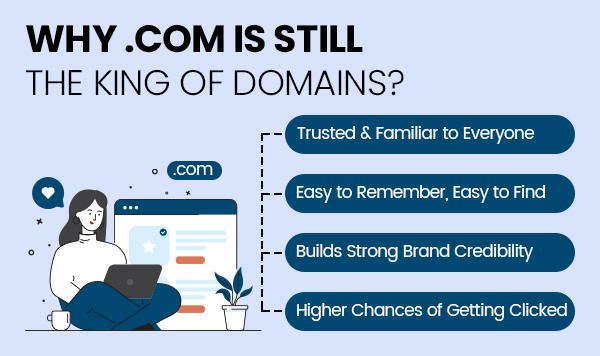
While Google doesn’t give .COM any special SEO advantage? But despite no favoritism, it continues to dominate the digital space, not because of algorithmic, but due to user trust, recognition, and branding power.
Here’s why a .COM domain still carries weight in 2026:
➔ Trust & Familiarity
People naturally trust what they know, and .COM has been around since the very beginning of the internet. It’s the most widely recognized and established domain extension globally, often seen as the default website ending.
According to GrowthBadger’s domain trust study, 33% more people say they trust a .COM over any other TLD.
Even though Google treats all domains equally, users don’t. When they see a .COM, they subconsciously associate it with legitimacy, professionalism, and credibility.
➔ Memorability
A .COM domain is easier to remember, type, and recall, especially when users don’t remember the full URL. When someone hears a brand name, their brain often autocompletes it with .COM. That’s free mindshare that newer extensions can’t match yet.
A study also revealed that over 70% of users type “.COM” by default when searching for a website directly, proving its memorability advantage.
For example, if you hear “KrishaStudio,” your instinctive guess is KrishaStudio.COM, not .co or .design. That’s the long-standing brand power of .COM.
➔ Brand Credibility
From startups to global corporations, a .COM domain still symbolizes authority and professionalism. For investors, customers, and even potential partners, it signals that your brand is established and reliable.
While newer TLDs like .io or .tech are gaining popularity, .COM still provides a sense of maturity and global reach, especially for businesses that aim to serve beyond one niche or region.
According to Forbes, .COM remains the gold standard for building long-term brand equity, especially for companies targeting global audiences.
➔ User Click-Through Rate (CTR)
Even though domain extensions don’t directly influence rankings, they can affect click behavior. Users are more likely to click on a .COM domain simply because they’re familiar with it and trust it more.
A report showed that websites with .COM domains enjoy a higher average CTR from organic search compared to less common TLDs.
So, while your .COM doesn’t help you rank higher, it can help you earn more clicks, which, in turn, indirectly supports your SEO goals by improving engagement metrics.
Also Read: How to Find All the Subdomains of a Domain?
What are the Cons of Buying a Non .COM domain?
While non-.COM domains (like .co, .store, .ai, or .tech) can be creative and industry-specific, they also come with certain drawbacks you should consider before finalizing your choice.
These downsides don’t hurt your SEO directly, but they can influence branding, credibility, discoverability, and trust perception among users.
➔ Availability issues
Ironically, one of the main reasons people don’t buy a .COM domain is that the good ones are already taken, but this problem doesn’t disappear with other extensions either.
Many popular keywords or brand names are already registered under multiple domain extensions, leading to potential confusion and competition. If someone already owns the .COM version of your name, they may get your traffic by default, especially if users instinctively type “.COM” after your brand name.
For example, if you buy “BrightLeaf.co” but “BrightLeaf.COM” already exists, users might end up on the other site, possibly a competitor.
A Namecheap analysis found that 68% of users automatically add “.COM” when manually typing a web address, which means owning the .COM version reduces the risk of traffic leakage and brand confusion.
➔ Expensive Premium Domains
While alternative extensions are often marketed as cheaper options, many of the best non-.COM names are sold as premium domains and can cost hundreds or even thousands of dollars upfront.
Registrars often price catchy or brandable non-.COM domains as premium due to demand. Plus, renewal fees for newer TLDs (.ai, .tech, .io, etc.) can also be significantly higher compared to standard .COM renewals.
A basic .COM domain usually costs around $10–$15 per year, while a premium .ai domain extension or .tech domain could easily exceed $65–$300 annually. According to GoDaddy’s domain pricing insights, premium domains can cost 10× to 100× more than regular ones, depending on keyword popularity.
➔ Renewal Costs Can Be Tricky
If you’re set on using a non-.COM TLD, check for the total cost of ownership, not just the initial price. Renewal rates often surprise first-time buyers. Some new TLDs not only charge more upfront but also have high renewal fees every year.
While a .COM usually renews for $10–$15/year, premium TLDs like .io or .ai might renew at $60–$100/year or more, and some premium tiers can exceed $200 annually.
Always check renewal pricing before purchasing; many buyers are caught off guard by these recurring costs.
Also Read: .COM Or .IN: Which Domain Is Better For Your Website?
What if the .COM Domain Taken?
You’ve finally come up with the perfect brand name, type it into a domain search bar, and the .COM version is already gone.
Frustrating?
Absolutely! But it’s not the end of the road; there are smart, strategic ways to work around it without compromising your online presence or SEO.
1. Try Variations of Your Brand Name
If your exact .COM domain name is taken; consider slight variations that keep your brand intact. You can add relevant words that fit naturally with your niche or purpose.
Examples: If GlowBeauty.COM is taken, go for GlowBeautyOnline.COM or GetGlowBeauty.COM.
Small tweaks can make your domain unique while keeping it recognizable and professional.
2. Consider Industry-Specific or Modern Extensions
If you can’t find a good .COM alternative, new TLDs can actually work in your favor, especially if they align with your industry. These extensions are modern, memorable, and increasingly accepted by users and search engines alike.
Examples:
- .store for eCommerce brands
- .tech or .io for software startups
- .design for creative agencies
- .ai for artificial intelligence or SaaS companies
31% of new businesses now use non-.COM TLDs confidently because they’re shorter, brandable, and industry-relevant.
3. Check Domain Marketplaces for Resale Opportunities
Sometimes, the .COM domain you want might be available, just not at regular pricing. You have to pay a little premium to get it. While this may cost more upfront, it can be worth it if the name perfectly matches your brand and long-term goals.
4. Protect Your Brand with Multiple TLDs
If you go with a non-.COM option, you can still buy the .COM version later when it becomes available, or purchase similar TLDs now to protect your brand identity.
For example, if you own glowbeauty.co, you might also buy glowbeauty.store to avoid impersonation and build a cohesive brand presence.
5. Focus on Branding Beyond the Extension
Your domain extension doesn’t define your success; your brand does. Strong storytelling, memorable design, and user trust can make any extension work just as well. Think of brands like Notion.so, Mirror.xyz, or DeepMind.ai, all thriving without .COM.
All in all, if your dream .COM is taken, don’t panic. You can still build a strong brand identity through creative variations, relevant TLDs, or secondary marketplaces. What matters most isn’t the extension, it’s how memorable, trustworthy, and aligned your domain feels to your audience.
Also Read: Can Buying a Domain Name from Someone Else be Possible?
If you are looking for .COM Domain or any Domain extension, reach out to Host IT Smart!
When you’re setting up your online identity, you need a reliable partner who understands your goals, and that’s exactly what Host IT Smart does. We don’t just help you buy a domain; we help you build a strong digital foundation that supports your business growth.
Here’s why businesses trust us:
★ Free .COM Domain with Hosting
When you choose any web hosting plan with Host IT Smart, you get a .COM domain absolutely free, giving your brand a trusted and professional start from day one.
★ Affordable Domain Registration
We make domain registration simple and cost-effective, offering the most popular domain extensions like .COM, .in, .net, and .co.in at transparent prices. No hidden costs, no confusion.
★ Transparent, Honest Pricing
What you see is what you pay. Host IT Smart is known for clear pricing with zero hidden charges, so you can plan your budget without surprises.
★ Domain Privacy Protection
Keep your personal information secure with our Domain Privacy Shield. It hides your private details from WHOIS lookups to protect you from spam, scams, and unwanted attention.
★ Easy Domain Management & Renewal
Manage DNS records, lock domains for safety, and receive smart renewal alerts so you never lose ownership, all through an easy, intuitive dashboard.
★ 24×7 Human Support (No Bots, Just Experts)
Whether it’s midnight or Monday morning, our support team is always available via call, live chat, WhatsApp, or ticket system. Quick responses, real solutions, and friendly help, every time.
At Host IT Smart, our mission is simple: to make your online journey effortless. Whether you’re registering your first domain, launching a website, or upgrading to a more powerful hosting solution, we’re here to ensure you get speed, security, and support every step of the way.

Register Your Perfect .COM with Host IT Smart!!
Final Verdict – Is .COM still the best domain?
Choosing the right domain extension doesn’t have to be complicated. Whether you go for a .COM, .IN, or any other extension, what truly matters is how well your website represents your brand, delivers value, and builds trust with your audience. A domain name is just the start; it’s your digital identity that grows as your business grows.
And when you’re ready to take that step, Host IT Smart makes it easy with affordable domain registrations, reliable hosting, and even a free .COM domain when you choose a hosting plan. It’s a simple, smart way to start your online journey with confidence and clarity.
Frequently Asked Questions
Yes, if it’s available. A .COM domain adds instant credibility, trust, and global appeal, especially if you plan to grow internationally.
.COM is a global domain, ideal for international audiences while .IN is India’s country-specific domain, best suited for local or India-focused businesses.
Yes. .COM is one of the original and most recognized top-level domains (TLDs) on the internet.
Yes, but it’s better to plan early. Rebranding or switching domains later can affect SEO, traffic, and brand consistency.
No. Google treats all TLDs equally in terms of SEO; ranking depends more on your content quality and user experience.
If the domain perfectly matches your brand or main keyword, yes, it’s a long-term investment that pays off in recognition and trust.