Highlights
- SEO helps photographers optimize their website so Google can understand their photos, services, locations, and style, making it easier for potential clients to find them through search.
- Most clients search for photographers online, and strong SEO increases visibility, boosts rankings, drives organic inquiries, and helps photographers attract bookings.
- Photography SEO works best when you combine optimized images, strong service pages, local SEO, blogging, reviews, and fast, SEO-friendly hosting.
Introduction
You’re a photographer with a stunning portfolio, dreamy edits, and a style that genuinely stands out. But when someone Googles best portrait photographer near me, your website is nowhere to be found. Meanwhile, a competitor with average photos but great SEO shows up at the top, gets the clicks, and books the clients.
Now pause… if this feels painfully relatable, you’re not alone. Most photographers nail the art but struggle with the algorithm.
That’s exactly why SEO for photography websites is no longer optional; it’s your silent sales partner. It’s what helps your images get discovered, your niche get recognized, and your bookings stay consistent.
Did you know, a photography business website saw a 522% traffic increase in six months after focusing on on-page, off-page, and technical SEO improvements.
If you would also like to experience the SEO magic for your photography website, then this blog is all you need.
What is SEO For Photographers?
SEO for photographers is basically your website’s way of raising its hand and saying, Hey, I’m the photographer you’re looking for!
When you understand the SEO Tips For Photography Website, you make it easier for search engines to read your work, understand your niche, and match you with clients who are already searching for your services. In simple words, SEO tips for a photography website help your photos get discovered.
Here’s a simple example: Let’s say you shoot maternity photos in Mumbai. If you sprinkle in the right keywords like maternity photographer in Mumbai, add meaningful alt text to your images, and organize your portfolio in a clean, search-friendly way, Google suddenly knows who you are, what you offer, and who should see your work.
The result?
You start showing up in the searches of people who are ready to book!
Why SEO Matters for Photographers?
➔ 68% of all online experiences start with a search engine, meaning most clients begin their photographer hunt on Google.
➔ 53% of all website traffic comes from organic search, making SEO the strongest long-term channel for lead generation.
➔ Local searches lead to 28% of conversions within 24 hours, which is huge for photographers who depend on location-based clients.
➔ Websites ranking on page one of Google capture over 90% of all clicks. If your photography portfolio isn’t there, clients simply won’t find you.
Also Read: Top Industries That Can Benefit From SEO
Understand How Google Sees Photography
If you want Google to shine a spotlight on your work, you first need to understand how Google actually views your photos. This is where many creators miss out: Google doesn’t feel your art the way humans do; it interprets it. And when you understand that interpretation, you unlock the secret behind the smartest SEO Tips For Photography Website.
Let’s break it down in a way that actually helps you rank!
1. Google Reads Images like a Viewer, but with AI.
Think of Google as a super-intelligent viewer who doesn’t get distracted by colors or emotions; it scans your image pixel by pixel. It identifies faces, objects, environments, colors, patterns, and even emotions, like happy family photos or a romantic couple shoot.
This is why the best SEO tips for photographers, like descriptive alt text, clean file names, and structured image data, matter. AI needs clues, and when you provide them, your images show up for the right audience.
2. Every photo tells a story, and Google reads that story through context.
Google doesn’t just rely on the image; it studies everything around it.
- Your title.
- Your caption.
- Your headings.
- Your paragraph text.
- Your gallery structure.
For example, if your image sits on a page about Maternity Photoshoot in Mumbai, Google will understand that the image belongs in that category, even if the photo itself is simply beautiful but vague.
This is where creators get the biggest advantage. Context is one of the best SEO tips for photographers, because it allows Google to fully understand the story behind every shot.
3. Your editing style now plays a bigger role than you think.
Google’s AI is becoming shockingly smart. It can now recognize photography styles like:
- Editorial
- Moody & dark
- Bright & airy
- Candid & documentary
- Cinematic tones
If your feed looks cohesive, Google sees consistency, which makes it easier for your site to rank in relevant visual searches. This is why creators who master stylistic consistency often perform better with SEO Tips For Photography Website.
Your aesthetic isn’t just art anymore; it’s a ranking factor.
4. EXIF & IPTC metadata quietly help Google recognize original owners.
While metadata doesn’t directly boost rankings, it strengthens your authority. Metadata includes:
- Camera model
- Lens settings
- Location data
- Copyright details
- Date & time
- Creator info
For photographers, this matters. Google can better identify original content, reducing the risk of stolen images ranking above yours. Anyone serious about how to do SEO for a Photography Website should keep metadata intact whenever possible.
It’s not a ranking booster; it’s a trust booster!
5. Alt text works like a mini photo description that Google relies on.
Alt text is one of the most underrated SEO tips for photography websites, yet it’s the one thing Google reads first.
Good alt text doesn’t say: Portrait photo.
It says: Sunset maternity photoshoot in Mumbai with a couple posing on Marine Drive.
Suddenly, Google knows who, what, where, and why. This is how your images start showing up in the top search and Google Image results.
Add personality, add detail, add keywords, just keep it natural.
6. Google loves clear, structured, purpose-driven portfolios.
A cluttered portfolio confuses Google just as much as it confuses clients. When your portfolio is organized by:
- Wedding
- Pre-wedding
- Newborn
- Fashion
- Product
- Maternity
Google immediately understands your business model.
A clean structure is one of the best SEO tips for photographers, because Google rewards websites that help users find what they want quickly.
The more organized your content, the easier it is for Google to index and rank it.
7. Google prefers fast-loading photos, even if they are high-quality.
Photography websites are naturally heavy. But slow sites lose rankings instantly.
Here’s the balance Google wants:
Beautiful photos → optimized for web → fast load time → strong user experience.
Using formats like WebP, compressing large files, and lazy-loading galleries are powerful SEO Tips For a Photography Website.
Fast site rank. Slow sites disappear.
8. Google loves information-rich content around your work—blogs, guides, behind-the-scenes, and FAQs.
This is where most photographers miss out. Google doesn’t want just photos—it wants expertise.
Many photographers also use an ai image generator to create mood boards, storyboard concepts, creative shoot references, and visual inspirations before planning client sessions.
When you publish blogs like:
- How to Prepare for a Newborn Photoshoot?
- Best Pre-Wedding Locations in Jaipur?
- What to Wear for a Couple Shoot?
…Google sees you as a trusted professional, not just another website.
This informational content increases time spent on your site, improves internal linking, attracts backlinks, and boosts your authority.
I’ve had a lot of success using SEO as a core marketing strategy for my photo business … these days, over 40,000 visitors to my site annually, which is wild. Treat SEO as a foundation, consistent content + service pages + location targeting can really pay off, even for small photography businesses.
Source: Reddit
Also Read: How to Make an SEO-Friendly Website?
Technical SEO That Photographers MUST Get Right
Before you think of keywords, blogs, or backlinks, let’s talk about the foundation, Technical SEO. This is the part of your website that Google looks at first. And when it’s done right, it makes everything else 10x easier.
Let’s get into it.
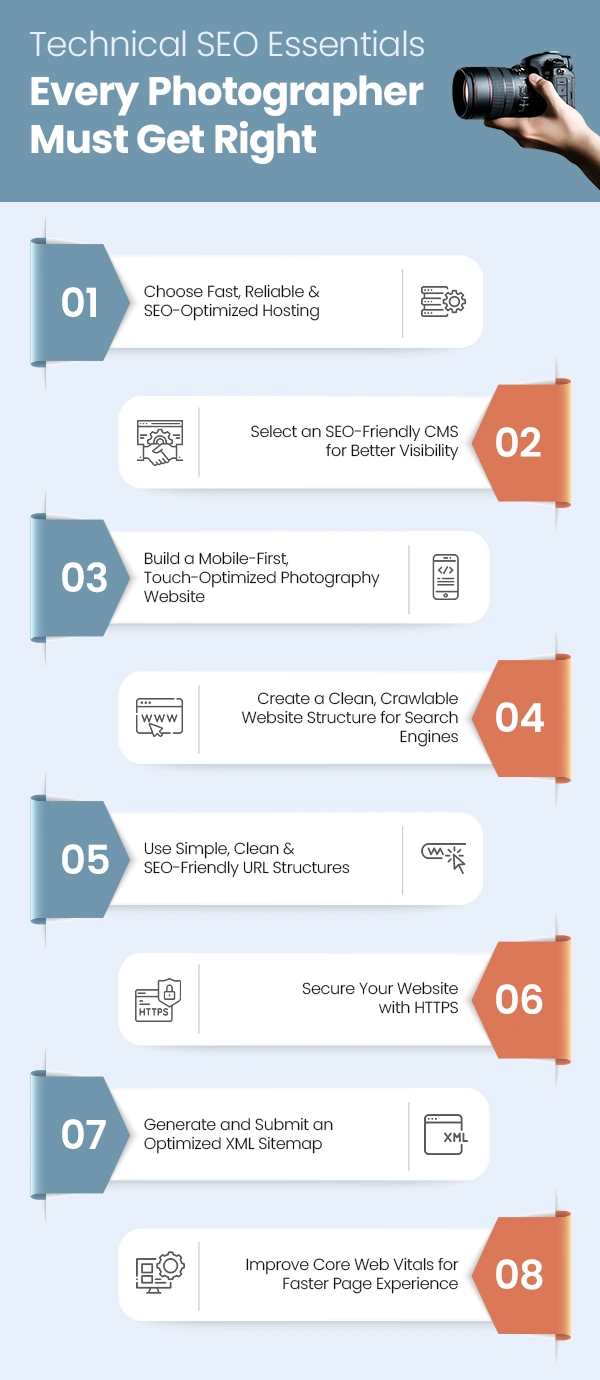
1. Choose a Fast, SEO-Friendly Hosting
Your hosting is your website’s engine. If the engine is slow, unstable, or crashes during high traffic, your rankings collapse, no matter how good your photos look.
This is why SEO friendly hosting is not a luxury but a necessity. It makes your work appear more professional to your target audience.
Choosing fast hosting = Faster pages = Better rankings. This is one of the most important SEO Tips For Photography websites, especially since photographers upload heavy media files.
Also Read: Ways to Prevent Website Crash From Traffic?
2. Choose an SEO-Friendly CMS
Whether you use WordPress, Wix, Squarespace, or Pixieset, your CMS should offer:
- Fast themes
- Image optimization options
- Clean code
- Easy SEO controls
- Flexibility for growth
Using the right CMS is quite important, as a rigid or poorly coded platform limits your ability to rank and scale. If you want to master how to do SEO for a Photography Website, start by choosing the best CMS for SEO that works with you, not against you.
3. Mobile-First, Touch-Friendly Website
Most people search for photographers on their phones, especially when making quick decisions. If your website loads slowly, scrolls awkwardly, or doesn’t respond to touch gestures on a mobile phone, users bounce instantly.
And, Google hates high bounce rates.
A mobile-first design is one of the best SEO tips for photographers, because great mobile UX directly impacts rankings and conversions.
Also Read: How to fix a Slow Website?
4. Create a Clean, Crawlable Site Structure
Think of Google’s crawlers like visitors exploring your studio. If it’s messy, confusing, or poorly labeled, they won’t know where to go. A clear site structure helps Google understand your services, location, galleries, collections, and blog categories.
A good structure improves:
- Discoverability
- Ranking potential
- User experience
Also Read: How to Find All Pages on a Website?
5. Use Clean URL Structure
Your URLs should look like this: yourwebsite.com/mumbai-maternity-photography
not
yourwebsite.com/p=2847&session=2
Clean URLs help Google understand your content instantly, improving your SEO strength. This is a simple but powerful SEO tip for a photography website that many photographers ignore.
Also Read: What Makes a Good Website Checklist?
6. Use HTTPS (SSL Enabled)
Google prioritizes trustworthy websites. An SSL certificate protects your site and boosts your rankings. Without HTTPS, browsers may show Not Secure, causing potential clients to exit before they even see your work.
Trust = Higher conversions + Better rankings.
Also Read: Does SSL Help SEO?
7. Create an XML Sitemap
An XML sitemap on a website tells Google: Hey, these are my pages, please index them correctly. It’s like giving Google a map of your portfolio so it doesn’t miss anything important.
This is a must-do among all the best SEO tips for photographers, especially for websites with large galleries.
8. Optimize Core Web Vitals
Core Web Vitals measure user experience based on:
- Loading speed
- Visual stability
- Interactivity
In simple terms:
- Your website should load fast.
- Elements shouldn’t jump around.
- Buttons should respond immediately.
Also Read: Which Functions are the Important on a Website?
The Real Game: Image SEO for 2026
If there’s one place where photographers can outrank anyone, it’s image SEO. And in 2026, Google is giving more weight than ever to visual search, AI-based image understanding, and original creator signals.
This is where the smartest SEO Tips For Photography Website come into play, because your photos aren’t just art… they’re SEO assets waiting to be optimized. Let’s talk about it.
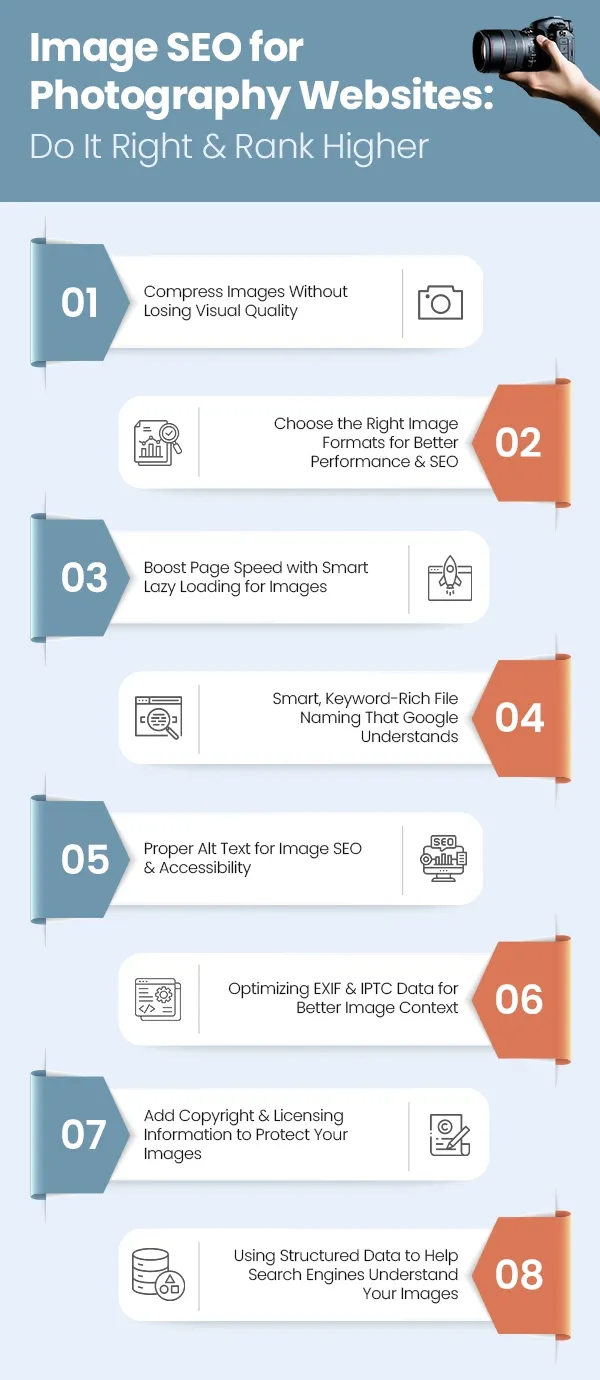
1. Image Compression Without Losing Quality
Your photos must look crisp, but they can’t weigh a ton. High-resolution images slow your site, hurt rankings, and create a bad mobile experience.
Tools like TinyPNG, ShortPixel, or your CMS’s built-in optimizer help maintain clarity while reducing file size. This is an important SEO tip for photographers, especially when galleries include dozens of images.
2. Use Image-Friendly Formats
By 2026, Google will favor modern formats like WebP and AVIF because they load faster while keeping high quality. Your JPG files still work, but they aren’t the future.
Switching formats instantly improves loading time, making this one of the best SEO tips for photographers who want speed without sacrificing beauty.
3. Use Lazy Loading for Images
Lazy loading ensures images load only when the user reaches them, not all at once. This dramatically boosts speed, Core Web Vitals, and user retention. For anyone learning how to do SEO for a Photography Website, lazy loading should be one of the first things you activate.
4. Smart File Naming That Google Loves
Your camera may save a file as DSC_9821.JPG…but Google has no idea what that means.
Rename your images like this instead:
mumbai-newborn-photography-session.jpg
goa-prewedding-beach-shoot.jpg
Smart naming strengthens keywords and context, making this an essential SEO tip for a photography website.
5. Don’t Forget Alt Text in Images
Think of alt text as a caption written for Google’s eyes. It should explain the scene naturally, like: Cinematic pre-wedding photoshoot at Goa beach during golden hour.
This helps with rankings, accessibility, and Google Images visibility, making it one of the strongest SEO tips for photographers.
6. EXIF/IPTC Optimization
By 2026, search engines will use more creator-data signals to identify original images. Keeping EXIF/IPTC data intact, camera model, lens, date, and author name helps Google understand authenticity. It doesn’t guarantee rankings, but it builds trust and reduces plagiarism issues.
7. Add Copyright & Licensing Info
Google now highlights images with clear copyright details. When you add licensing info, you protect your work and boost credibility. This matters especially for commercial, editorial, and wedding photographers showcasing original content.
8. Add Structured Data for Images
Schema markup helps Google understand:
- The subject of your image
- The location
- Who created it
- What style does it belong to
- Licensing information
Structured data is becoming a ranking differentiator, especially for creative professionals, and it supports Google’s AI understanding as well.
Also Read: Will AEO Replace SEO?
The Ultimate Guide to Do SEO for a Photography Website
1. Create High-Value SEO Pages (Your Money Pages)
If your website is a studio, then your money pages are the rooms your clients walk into when they’re ready to book. Most photographers skip this and simply upload galleries, but Google and your clients both need dedicated, high-value pages that show your expertise, style, services, and personality.
Here are the essential pages every photographer needs:
a. Wedding Photography Page
This is usually the highest-earning page on a photographer’s website.
It should include:
- Target location keywords
- Your best wedding shots
- Your style explanation
- FAQs
- Pricing overview
- Client stories
- Call-to-action buttons
This page is the perfect place to apply the best SEO tips for photographers, because wedding searches are highly competitive and highly profitable.
b. Pre-Wedding Photography Page
Couples start searching for ideas months in advance, and Google rewards pages that answer their questions.
Your pre-wedding page should include:
- Location ideas
- Styling tips
- Your best shots
- Behind-the-scenes notes
- Storytelling captions
This helps Google identify you as an expert & helps you rank higher.
c. Portrait Photography Page
Portraits are emotional purchases. Clients want to feel something.
Your page should highlight:
- Your signature editing style
- The experience you create
- Close-up shots
- Personality-driven copy
- Who the page is for (actors, models, kids, professionals, creators, etc.)
Strong portrait pages rank extremely well when optimized with solid SEO tips for photographers.
d. Event Photography Page
Events include birthdays, corporate functions, baby showers, brand launches, and more. Google loves niche event pages because people search very specifically.
Your page should include:
- Event types you cover
- Sample galleries
- Turnaround time
- Equipment highlights (optional)
- Testimonials
This helps you catch long-tail, high-intent searches that most competitors miss.
e. Fashion Photography Page
Fashion clients want clarity and professionalism.
Your fashion page should showcase:
- Editorial shots
- Studio work
- Collaboration details
- Magazine shoots
- Brand campaigns
- Your lighting style
Use keywords and descriptions naturally; Google and fashion clients both respond to well-structured, stylish pages.
f. Product Photography Page
With eCommerce booming, product images on eCommerce pages can attract tons of traffic.
This page should include:
- Product categories you shoot
- Before/after examples
- Commercial lighting setups
- Image usage rights
- Brand collaborations
For commercial niches, this becomes one of the highest-converting pages when combined with strong SEO Tips For Photography Website.
2. Create Location-Based Pages
If you want to dominate Google locally, location-based pages are non-negotiable. When someone searches wedding photographer in Mumbai or a pre-wedding shoot in Delhi NCR, Google prioritizes pages built specifically for that location.
These pages allow you to target:
- Your city
- Nearby areas
- Tourist spots
- Popular shoot locations
- High-intent regional keywords
For example, instead of a single Wedding Photography page, you can create:
- Wedding Photographer in Mumbai
- Wedding Photographer in Pune
- Wedding Photographer in Jaipur
- Destination Wedding Photographer in Goa
This is one of the most powerful SEO Tips For a Photography Website, because Google loves specificity. If you want to master how to do SEO for a Photography Website, these pages help you rank where most clients come from, your local area.
Also Read: Which Businesses Benefits From Local SEO Practices?
3. Service + Style Combination Pages
Another top SEO tip for photographers is to focus on their niche. Most photographers attempt to rank for broad terms like Wedding Photography, which is extremely competitive. But when you niche down with style + service, Google sees you as more relevant and authoritative.
With this, photographers can crush their competition with smart, zero-fluff SEO. Google loves pages that clearly define what you do + how you do it.
Think of these like hybrid service pages that reflect your signature style.
Examples:
- Candid Wedding Photography
- Cinematic Pre-Wedding Photography
- Editorial Portrait Photography
- Documentary-Style Event Photography
- Fine-Art Maternity Photography
4. Portfolio Page That Actually Helps SEO
Most photographers think a portfolio page is just a gallery. But a gallery alone does nothing for SEO.
A high-performing portfolio page needs:
- Descriptive text
- Keyword-focused headings
- Themed sections
- Image alt text
- Internal links to service pages
- Client stories or short captions
- Fast-loading images
When you treat your portfolio page strategically, it becomes a ranking machine, not just a visual showcase.
This is where many creators go wrong: They upload 200 images with zero descriptions, zero context, zero usability.
Google can’t rank that!
A strong portfolio page should:
- Describe your style
- Highlight your strengths
- Guide visitors to money pages
- Give Google enough text signals to understand your niche
Optimized correctly, your portfolio becomes one of the strongest SEO tips for photographers and improves both ranking and conversions.
5. Blogging for Photographers (Not Boring, Actually Helpful!)
Most photographers feel blogging is boring, time-consuming, or not their thing. But here’s the truth: Blog posts are the easiest way to show Google that you’re an expert, and clients LOVE content that guides them.
Your blog doesn’t need long essays. It needs useful, helpful, experience-based content such as:
- Best Pre-Wedding Shoot Locations in Mumbai
- What to Wear for a Newborn Photoshoot
- How Much Does Wedding Photography Cost in India?
- Cinematic vs. Candid Wedding Photography, Which Is Right for You?
This kind of content helps Google trust you, boosts your authority, and boosts your rankings and conversions.
6. Local SEO: Our #1 Ranking Superpower as a Photographer
If there’s one SEO strategy that moves the needle fastest for photographers, it’s local SEO. Clients don’t search globally; they search for someone near them, someone they can book today, someone familiar with their city, venues, and vibe.
Google cares about three things here: Relevance → Proximity → Trust.
So your job is to give Google as many signals as possible that you are the go-to photographer in your area.
This means:
- Setting up and fully optimizing your Google Business Profile
- Adding consistent NAP details (Name, Address, Phone) across directories
- Publishing locally relevant blog posts like “Best Pre-Wedding Spots in Pune.
- Collecting reviews with real photos and detailed experiences
- Creating location-based service pages (Maternity Photographer in Jaipur, Wedding Photographer in Goa)
Master this, and Google will put you in front of high-intent searchers who are actively ready to book. In terms of pure results, this is one of the strongest SEO tips for photographers you’ll ever use.
7. Backlink Strategy (Zero-Spam Approach for Photographers)
Backlinks are still one of Google’s top ranking signals, but photographers don’t need complicated link-building hacks. You just need real, context-rich links from businesses and creators you naturally work with.
The best part?
These links come from collaborations you’re already doing. Your easiest backlink opportunities include:
- Wedding portals (WedMeGood, WeddingWire, Shaadi.com)
- Event planners who showcase your work in their portfolios
- Makeup artists who need high-quality shoot images
- Venues that feature your weddings on their website
- Bloggers and influencers who credit you for photography
- Features in local magazines & blogs reinforce your identity as a trusted, verified entity
Each of these links tells Google you’re trusted in the industry, and that trust boosts your rankings far more than any mass-spam link campaign ever could. This is one of the best SEO tips for photographers because it builds authority and opens new referral channels at the same time.
Also Read: Difference Between On-page and Off-page SEO?
8. Social Media + SEO Combo
Social media and SEO used to feel like two separate worlds, one for creativity, one for Google. But in 2026, they work together more tightly than ever and is among the best seo tips for photography websites. When your social content performs well, it creates signals that Google pays attention to & it leads to:
- Higher branded searches (your name + photographer), a major trust signal
- Increased traffic from social profiles to your website
- Longer engagement when people explore your content further
- More shares and mentions, which strengthen online authority
- Better content distribution, helping new blogs and pages get initial traction
Platforms that actually matter for photographers:
- Instagram – best for visual portfolio + branded search
- Pinterest – pins rank in Google Images and send long-term traffic
- YouTube / Shorts – video drives authority and ranks in search
- TikTok (if applicable) – boosts visibility and brand demand
- LinkedIn – powerful for corporate and commercial photographers
In short: Social media creates demand → SEO captures and converts that demand.
9. Performance Monitoring: How to Track Your SEO Results
Monitoring your traffic performance helps you understand whether your SEO efforts are working. These SEO tools give you clarity, direction, and data-driven next steps.
Tools to Use:
➢ Google Search Console
Track your keyword rankings, clicks, impressions, indexing status, and which pages Google considers most important. It helps you see what’s improving and where you need to optimize more.
➢ Google Analytics
Understand your traffic sources, user behavior, session duration, conversions, and which pages attract or lose visitors. This shows what content resonates and what needs refinement.
➢ Hotjar (User Behaviour Insights)
Use heatmaps, scroll maps, and click tracking to see how people interact with your pages. This helps you identify UX issues, drop-off points, and layout improvements that can boost engagement—and ultimately support stronger SEO results.
Together, these tools create a full picture of your SEO performance and help you make smarter, more confident decisions as your photography site grows.
Also Read: How is Ranking Different When Comparing PPC vs SEO?
10. What Metrics Actually Matter
Photographers don’t need 50 complicated SEO metrics. You only need the ones that truly show whether your visibility, traffic, and inquiries are growing.
Here’s what matters most:
➔ Organic Leads
The real win. Track how many inquiries, calls, form submissions, and bookings come directly from Google. If this number grows, your SEO is working.
➔ Local Pack Visibility
Showing up in the top 3 Google Maps results is more valuable than ranking #1 organically for many photographers. This metric directly affects bookings, especially for weddings, events, maternity, and portraits.
➔ Image Impressions
Since photography is a visual business, Google Images is your silent lead generator. More impressions mean Google understands your photos and is showing them to the right audience.
➔ CTR From Gallery Pages
Click-through rate from your gallery or portfolio pages shows how compelling your thumbnails, titles, and previews are. High CTR means your visuals are doing their job, pulling people deeper into your site.
➔ Conversion Rate From Landing Pages
Track how many visitors on your service pages actually turn into inquiries. Even small improvements here can dramatically increase bookings.
These are the numbers that actually move your business forward, and keeping an eye on them helps you adjust your SEO strategy with confidence.
Also Read: Click-through Rate (CTR) vs Conversion Rate
Conclusion
If you’ve made it this far on the best seo tips for photography website, you already understand something most photographers miss: great photos alone don’t bring clients, great visibility does. SEO isn’t about complicated tactics or robotic checklists; it’s about helping the right people discover your work, connect with your style, and trust you enough to reach out.
When you put the right strategies in place, your website turns into a 24/7 marketing engine.
Your rankings rise, your inquiries grow, and your brand becomes the go-to choice in your city and niche.
And if you want to make all of this even smoother, a reliable foundation matters. That’s where Host IT Smart comes in. With fast, SEO-friendly hosting built to handle image-heavy photography websites, it helps you improve speed, stability, rankings, and ultimately, business growth.
To get started with the foundation, Host IT Smart is here. Let’s get started.
Most photography websites start seeing improvements within 3–4 months, but strong rankings and consistent leads typically take 6 months or more, especially if you’re applying the best SEO tips for photographers consistently.
The biggest mistakes include not using alt text, slow-loading galleries, missing location pages, no Google Business Profile, thin service pages, and ignoring blogging.
Yes, AI helps with keyword research, content ideas, blog outlines, and even organizing how to do SEO for a photography website. It speeds up strategy and execution, but you must add your voice and expertise for the best results.
ChatGPT can assist with content, keyword planning, alt text ideas, blog structures, and SEO tips for photographers, but the final execution, uploading, optimizing, compressing, and improving UX, still depends on you or your team.