Keywords and SEO – these two terms are the parallel circuit of digital marketing. Although, if they don’t have the right balance with each other, they can cause havoc in the SEO and ranking of your website on SERP.
To strike a balance between them, you first need to figure out the main question – How many keywords should I use for SEO? Wondering how you will unravel this mystery? Stop right there! Read below to determine the keyword density and some mind-boggling SEO strategies.
Before we jump directly to answer your question, let us first understand what keywords are and why they are important.
An Overview Of Keywords
Technically speaking, keywords refer to word(s) and phrases searched by web users on search engines. Keywords can comprise two, three, or more words. Generally, there are short-tail keywords or head terms that include 1 to 3 words and then come in long-tail keywords with 3 or more words. Besides these two main categories, there are numerous other types of Keywords in SEO, such as LSIs.
They are typically used in website content, blogs, meta descriptions, product descriptions, promoting services, ads, and other content types. You will know how keyword stuffing works if you are a marketer or a writer. However, if you’re not aware, here’s an example to help.
For instance – you are a marketing executive aiming to generate potential leads and increase sales for a clothing brand. Your primary goal would be to identify which keywords to shortlist and how to use them.
Initially, you would analyze competitors and identify relevant, industry-specific keywords. These keywords will be included in product/service pages, blogs, ads, meta descriptions, and other relevant content types.
Finally, users looking to buy clothes will type a search query such as clothing brand near me. Your content will appear in the search results for your user’s query if it contains the same or a related keyword.
In this AI era, let’s go through how AI changed keyword strategy below.
Also Read: Top Industries That Can Benefit From SEO In 2023
How AI Has Changed Keyword Strategy?
Search engine optimization has evolved significantly over the years, but the rise of AI in search has brought one of the biggest shifts yet. Earlier, keyword strategy was mostly about finding the right terms, placing them strategically, and matching user queries as closely as possible. Today, that approach alone is no longer enough.
AI-driven search systems now focus on understanding meaning, context, and user behavior. This has transformed how businesses and content creators approach keywords. It is no longer just about what people type into the search bar, but why they are searching in the first place and what kind of answer they expect.
The Shift from Keywords to Search Intent
One of the biggest changes brought by AI is the shift from keyword-focused strategies to intent-driven content. Search engines now prioritize understanding what the user is actually looking for rather than just matching the words they type.
- AI-driven features like Google AI Overviews have reduced clicks on traditional blue links. Users often get their answers directly on the search results page, which means your content needs to be strong enough to be selected as a source for these summaries.
- Ranking is no longer dependent on exact-match keywords alone. Simply repeating a keyword multiple times does not guarantee visibility. Instead, search engines evaluate how well your content answers a query, how relevant it is, and whether it provides real value.
- Context and topical authority now play a much bigger role. Websites that cover a subject in depth, connect related topics, and provide clear, helpful information are more likely to rank. This means that creating content clusters, answering related questions, and building expertise in a niche are more important than ever.
Optimizing for AI-Generated Results
To succeed in an AI-driven search environment, content needs to be structured in a way that is easy for both users and search engines to understand.
- An answer-first content format is becoming essential. Instead of long introductions, users and AI systems prefer content that directly answers the question at the beginning, followed by detailed explanations. This increases the chances of your content being picked for featured snippets or AI-generated summaries.
- Adding concise summaries under headings also helps. When each section clearly explains a specific point in a short and structured way, it becomes easier for AI to extract and display that information in search results.
- Using structured data, such as the FAQ and HowTo schemas, improves visibility. These elements help search engines understand the purpose of your content and increase the chances of appearing in rich results.
- Writing in a conversational tone is equally important. AI systems are designed to mimic human understanding, so content that feels natural, clear, and easy to read performs better. Avoid overly complex language and focus on explaining concepts in a simple and engaging way.
In this new landscape, keyword strategy is no longer just about targeting phrases. It is about understanding users, answering their questions effectively, and creating content that aligns with how AI-powered search engines process and deliver information.
Thus, a combination of AEO & SEO is what will be required to gain success of your online website’s performance
Also Read: An In-Depth Guide On Fresh Keywords
Start With Keyword Research
Starting with keyword research is key for creating content that resonates with your audience. Use tools like Google Keyword Planner or Ahrefs to find keywords with a good mix of search volume and low competition.
For example, imagine you own a small online store selling eco-friendly kitchenware. Keyword research may reveal that “eco-friendly kitchen products” has a decent search volume but is highly competitive.
Digging deeper, you might find “biodegradable kitchen sponges” or “sustainable kitchen cleaning tools” as lower-competition, high-intent keywords that better match what users are specifically seeking.
Keyword research also helps you understand user intent, ensuring your content matches what people are actually looking for and increases engagement.
Also Read: Which Businesses Benefits From Local SEO Practices?
Why Are Keywords Important In SEO?
If we had to answer in one line, it would be: to achieve a desired goal aligned with your business and defined parameters. As mentioned above, including relevant keywords in your content puts you one step ahead. The search algorithm comprehends the user’s search query and phrases in your content. Your content will rank at the top of the SERPs if it uses the right search terms and is high-quality.
- How Many Keywords For SEO Should Be Used?
Defining an ideal number of keywords for SEO is nearly impossible because numerous factors come into play when including keywords in a piece of content, such as your objective, the content’s word count, location, target audience, subject, and ad campaign.
Even after figuring out these aspects, the density still remains a question. Moreover, stuffing too many keywords is never the solution, as Google favors keywords that fit naturally in the content. Plus, the cost of purchasing each keyword might burn a hole in your pocket.
So, exactly what keyword density should be right for SEO?
According to HubSpot, using 1 or 2 keywords per 100 words of copy is considered good keyword density. A few search engines might respond well to 0.5% keyword density.
To identify the volume of keywords, you can leverage certain tools such as –
- Keyword Density Checker
- SEOBook Keyword Density Analyzer
- Copywritely Keyword Density Checker
- Semrush’s On-Page SEO Checker
Now that you know how many keywords to use for SEO, we shall move on to keyword density for each page.
Also Read: 15 Best SEO Audit Tools For Your Website (Free+Paid)
- How Many Keywords Should You Focus On Per Page?
Previously, we discussed the importance of keywords and how many to use for SEO. Now, we will focus on other aspects of keywords per page.
1. The Density of Keywords Per Page
As mentioned above, underlining a fixed amount of keywords is not feasible, and you need to consider numerous other factors to define the volume. Although marketers typically break down the keywords into two categories – 1 Primary or main keyword (the targeted keyword) and others as secondary keyphrases.
Although marketers typically break down keywords into two categories: the primary or main keyword (the targeted keyword) and the others as secondary keyphrases.
For instance, the primary keyword is “luxurious cars in Dubai,” and other keywords might include “luxurious cars,” “cars in Dubai,” “top cars in Dubai,” and so on. These keywords look similar, but they differ in terms of search variation and volume.
In addition, you can always use the keyword formula to determine the required density.
Formula –
10 (keywords in the content) / 1000 (words in the content) = .001
Now, multiply this answer by 100 to get the exact density.
.001 x 100 = 1%.
This means you need 1% of keyword stuffing in 1000 words of content. Similarly, you can use this formula to define the volume of keywords for other content.
2. What Is Keyword Stuffing
Keyword stuffing refers to repeatedly using the same phrases or words in the content. Multiple keywords are usually stuffed to get better visibility and manipulate positions in the SERPs, but instead, they actually make you invisible.
3. Can A Website Have Too Many Keywords?
Absolutely not! The volume of keywords should always be balanced, not more, not less. Putting too many keywords can negatively affect your website/page on the SERPs. You must always include keywords that naturally fit the content.
4. How Keyword Stuffing Can Impact Your Growth
Stuffing too many keywords negatively impacts a site or a page. Meaning visitors will head to another site as soon as they realize your site has too many keywords and adds little to no value to their search query. This outdated practice can not only obstruct the user experience but also violate search engine guidelines and SEO best practices.
According to Google’s quality guidelines, “Filling pages with too many keywords or numbers can result in negative user experience likewise can impact your site’s ranking.”
However, you are still not at a disadvantage. The search algorithm will either overlook the keyword stuffing or classify the web page as over-optimized.
5. Why Drafting Relevant And High-Quality Content Is Important?
To rank on the SERP, you must create relevant, high-quality content. Instead of stuffing too many keywords, focus on creating content that entertains a reader and solves the purpose of visitors visiting your site/page.
Not only we but also Google agrees to this. Google rolled out a clearly defined statement — “Focus on creating useful, information-rich content that uses keywords appropriately and in context.”
Following this rule of thumb can boost your site or page’s ranking on SERPs. Google acknowledges and indexes content that aligns with its predefined guidelines.
Now that you have an overview of how many keywords per page, the next point is things to consider when determining the keywords.
Also Read: Best Content Management System Platform Optimized For SEO
How do you optimize content for keywords?
To truly drive traffic and conversions, optimizing for keywords is essential. Keyword optimization isn’t just about adding search terms—it’s about strategically crafting content to align with what users are searching for. By targeting high-traffic keywords, aligning with search intent, and implementing structured on-page SEO, you set the stage for consistent, quality traffic.
Let’s dive into methods that make your content easy to find and SEO-friendly, boosting your site’s visibility and engagement effectively.
- Targeting Keywords with Traffic Potential
Choose keywords with solid search volume and relevance to your niche. Start by researching terms that your audience is actively searching for. Tools like Google Keyword Planner, Ahrefs, or SEMrush can show you keywords that drive traffic.
Aim for a balance between search volume and keyword difficulty to find terms where you can rank effectively.
- Mapping Your Keywords
Organize keywords by intent (informational, commercial, transactional, navigational) and topic. Use primary keywords as your main focus and support them with relevant secondary keywords. This helps search engines understand the context of your content and makes it easier for readers to follow.
- Aligning with Search Intent
Ensure your content matches the purpose behind a search query, whether it’s answering a question, providing a service, or selling a product. If searchers want to learn, prioritize educational content; if they’re looking to buy, emphasize product details and benefits. Matching intent increases engagement and ranking potential.
- Covering Comprehensive Information
Include all essential aspects of your topic. Anticipate what users want to know and provide answers in a detailed, structured format. By fully covering the topic, you increase the chances of ranking for a broader range of keywords and decrease bounce rates as users find all the information they need in one place.
- Making Content Easy and Enticing to Read
Format your content for readability: use short paragraphs, bullet points, headers, and visuals. Write in an engaging, conversational tone to maintain reader interest. Quality visuals, relevant examples, and clear explanations make complex ideas easier to digest and hold attention.
- Crafting a Compelling Title Tag and Description
Titles and meta descriptions are critical for attracting clicks in search results. Make your title catchy, relevant, and keyword-rich. The description should summarize the content’s value in a few words, prompting curiosity. Both the title and description should include primary keywords to signal relevance to search engines.
- Building Quality Backlinks
Backlinks from credible sites improve your content’s authority. Promote your content through guest posting, partnerships, or social sharing to attract natural links. High-quality backlinks demonstrate to search engines that your content is trustworthy, which is crucial for better rankings.
- Optimizing for Rich Snippets
Use structured data (schema markup) to increase the chances of your content appearing in featured snippets or rich results. This can include star ratings, images, or FAQs directly in the search results. Not only does this improve click-through rates, but it also enhances visibility and credibility.
Also Read: How to Make an SEO-Friendly Website?
How Many Keywords Should You Track?
The number of keywords to track depends on your business size, goals, and resources. For a small business focusing on niche areas, tracking 10–20 relevant keywords could provide valuable performance insights without overwhelming data.
For larger websites with broader target audiences, 50–100 keywords per segment might be necessary to monitor multiple categories and capture market shifts.
To determine an effective range, consider keywords that truly represent user intent and align with your content strategy.
For example, an online bakery might start by tracking “birthday cakes online,” “chocolate cake delivery,” and “bakeries near me” to understand the search demand in their niche.
As they grow, they might expand to track keywords for specific products or seasonal offerings, like “holiday cupcakes” or “wedding cakes.”
Regularly reviewing and refining the keyword list is essential for adaptability. Often, high-value keywords change, making it important to evaluate whether your tracked keywords still align with search trends and conversion goals.
Tracking keywords this way can provide comprehensive insights while keeping the data scope manageable.
Factors To Consider When Determining The Keywords Density
1. Size & Searches
This point depends entirely on the size and the number of daily search queries that appear on the site. Firstly, let us explain the size. Targeting multiple keywords may be difficult for a small site (12-15 pages). Under such circumstances, we recommend targeting fewer yet relevant, competitive, and high-density keywords.
However, the scope of targeting multiple keywords increases if you have a large site with 100 or more pages. For effective targeting, prioritizing the collection of multiple relevant keywords is advisable.
Keyword targeting also depends on the search query. For instance, you have a salon website offering various services. However, your services are not clearly defined, and you are not targeting multiple keywords despite having a considerable number of search queries.
Now, What Shall Be Done?
It is advisable to clearly define your services by creating multiple pages, targeting relevant keywords, and incorporating them into your content.
This will not only attract the target audience but also improve your site’s ranking on SERPs.
Also Read: How Is Ranking Different When Comparing PPC Vs SEO?
2. Niche & Target Audience
This is the second most important pointer when determining keywords. Niche here means identifying keywords related to your business/industry. They can also be referred to as industry-related keywords.
These keywords are relatively hard to determine and rank since they are industry specific, unlike trendy keywords that are easy to find and rank.
Generally, these keywords are targeted to prompt a user to take action for any purchase. Let’s assume you have sports shoes selling site. A user is all set with the decision to purchase new shoes online.
The user types a clearly defined search query – “Black Puma sports shoes near me”. Regardless of a sports shoe site, you don’t have this keyword on your site. So, what now? Unfortunately, your site won’t appear in the search results because you have included keywords like “footwear near me,” “shoes,” and “brand new shoes” that aren’t relevant to your niche.
If your business falls within a niche category, we recommend targeting industry-specific keywords.
Additionally, your target audience is another major priority when identifying keywords. Specifying the target audience helps understand who is searching for the keywords that might lead to your website.
Suppose you are a tattoo artist whose target audience is people interested in getting tattoos, especially those who get them frequently. However, you are targeting the wrong audience, or a broader range of audiences, who are uninterested in tattoos. Doing so will gain you nothing. You will not get new customers at your storefront and will waste a lot of money.
We recommend that you understand your target audience’s demographics, preferences, and other factors to determine which keywords to use to drive them to get tattoos from you.
Also Read: How SEO and SEM Work Together?
3. Competitor Analysis
Competitor analysis is the last but not the least primary factor when finding keywords. These analyses provide a strategic approach to identifying the keywords your competitors use on their websites. The goal of this process is to target relevant keywords in your content and outrank your competitors.
Suppose you have a toy store; you can look out for your competitors to see the keywords they use and the search volume they track. By checking the keyword density, you can figure out how many times you should use the relevant keywords in the content to outperform them. The process gives an overall balance of keyword density.
Why Keyword Density Is No Longer a Primary Ranking Factor?
There was a time when SEO largely revolved around how many times you could use a keyword within a piece of content. The idea was simple: the more frequently a keyword appeared, the higher the chances of ranking. But search engines have evolved significantly since then, and so has the way they understand content.
Today, keyword density is no longer a primary ranking factor. Modern search algorithms focus on context, intent, and overall content quality rather than just counting keyword repetitions. This shift means that writing naturally and covering a topic comprehensively is far more important than trying to fit in a keyword a specific number of times.
- Over-Optimization Can Harm Rankings
Trying to force keywords into every sentence can actually work against you. This practice, often called keyword stuffing, makes content feel unnatural and difficult to read. Search engines are now sophisticated enough to detect such patterns and may penalize websites that rely on over-optimization.
From a user perspective, overly repetitive content reduces trust and engagement. Visitors are more likely to leave a page that feels robotic or spammy. As a result, metrics like bounce rate and time on page can suffer, which indirectly impacts your rankings as well. - Google Understands Synonyms & Variations
Search engines no longer depend on exact keyword matches to understand what a page is about. They can recognize synonyms, related terms, and different ways of expressing the same idea. This means you do not need to repeat the same keyword multiple times to rank for it.
For example, if your target keyword is about web hosting, using related terms such as hosting services, website hosting, or server hosting helps search engines understand the broader context of your content. This approach not only improves readability but also increases your chances of ranking for multiple related queries. - Natural Language Is More Effective Than Forced Repetition
Content that sounds natural performs better both for users and search engines. When you write in a conversational and human-friendly tone, it becomes easier for readers to understand and engage with your content.
Search engines are designed to prioritize helpful and relevant information. If your content answers user queries clearly and naturally, it is more likely to rank well. Forced repetition of keywords does not add value and can make your content less effective.
Also Read: How to Write Website Content Using ChatGPT?
Focus on:
- Topic coverage
Start with topic coverage. Make sure your content thoroughly explains the subject and answers common questions users may have. The more complete your content is, the more useful it becomes. - Semantic Variations
Next, include semantic variations. Use different words and phrases that relate to your main topic. This helps search engines understand the depth of your content and improves its visibility for a wider range of search queries. - Related Entities
It is also important to include related entities. These can be concepts, tools, or terms connected to your topic. Including them naturally strengthens the context and authority of your content. - Contextual Relevance
Finally, focus on contextual relevance. Ensure that every part of your content aligns with the main topic and provides meaningful information. Avoid adding keywords or sections that do not contribute to the overall value.
In today’s SEO landscape, success comes from writing content that is clear, helpful, and aligned with user intent. When you shift your focus from keyword density to content quality, you create a stronger foundation for long-term rankings.
This was our take on explaining the factors to highlight the density of the keywords. Let’s hop to the next topic — Keyword strategies.
Also Read: How Many Articles Do I Need For Starting a Blog?
4 Sure-shot Keyword Strategies To Advance In SEO
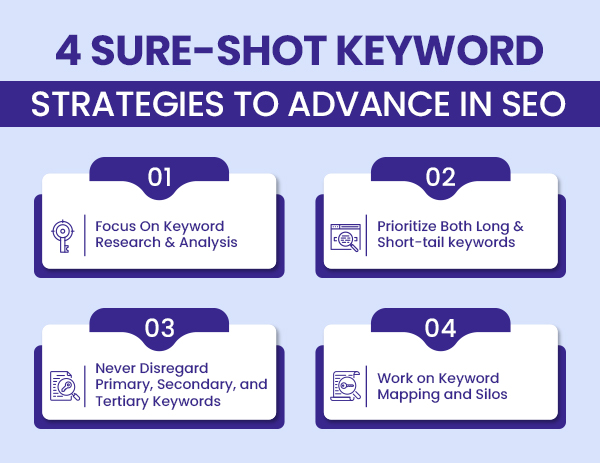
1. Focus On Keyword Research & Analysis
As mentioned earlier, keywords and SEO are closely related. For ranking on SERPs, using the right and relevant keywords is essential. Publishing content without adding keywords is pointless, as these phrases are crucial to your business’s growth and achieving the desired outcome.
To do so, focus on determining and analyzing the search terms used by web users in search engines. If you are a renowned website, adding high-volume keywords will increase clicks and improve traffic. However, if you are a startup website, we recommend considering low-volume keywords to jump ahead of the competition. You can make use of amazing SEO tools for this process.
Additionally, identifying relevant marketing sites for guest posting can complement your keyword strategy by helping you build quality backlinks and improve your domain authority.
Mind you, keyword research and analysis is not a one-time strategy. Industry experts claim to revisit your keyword strategy quarterly and at least 3-6 months before any campaign or promotion is needed. Revisiting keyword strategy at regular intervals helps your site stay relevant and fresh.
Hence, focusing on keywords is vital, especially from SEO’s perspective. This ensures you stay at the top of the game and gain maximum impact.
Also Read: What Is A Sitemap & Why Do You Need It?
2. Prioritize Both Long & Short-tail keywords
Previously, we gave you an overview of long and short-tail keywords. Here, we will explain why they should be prioritized. Many marketers suggest supporting long-tail keywords because their search demand curves are high. Although we recommend you prioritize both equally.
The content should include a mix of long- and short-tail keywords to boost rankings and attract more users based on their search intent.
Both keywords have their benefits. For instance –
- Short-tail keywords have high search volume and keyword difficulty. They are relatively less-focused search terms since the intent is unclear. Their cost is high, and offers lower conversion rates.
- Short tail keywords have a high search volume and keyword difficulty. They are relatively less focused search terms since the intent is not clear. Their cost is high, and offers lower conversion rates.
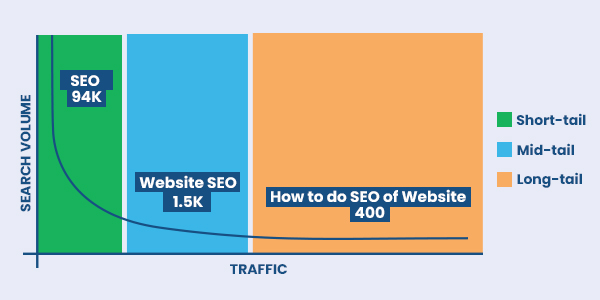
As shown in the example above:
- The keyword “SEO” has high search volume, but its ability to drive traffic engagement is very low.
- The keyword “Website SEO” in between has a higher chance of driving traffic engagement than the short-tail keyword.
- Now, when we come to the keyword “How to do SEO of Website,” it has the lowest volume, but it has the potential for higher traffic engagement compared to short & mid-tail keywords.
This shows that you can’t ignore long-tail keywords at all, even though it has low volume. Although, mapping out a powerful keyword strategy based on your objectives will lead to a consistent and quick outcome.
3. Never Disregard Primary, Secondary, and Tertiary Keywords
While many might be aware of primary, secondary, and tertiary keywords, a few are still not recognized as belonging to these three types. To outline –
- The primary keyword is believed to be the main keyword in content. It is targeted at the top in the title, meta description, URL, and the first few lines of the content since it has higher conversion rates and search volume.
- A Secondary keyword refers to the supporting keyword in the content. The secondary keyword is usually paired with the primary keyword to achieve the perfect balance of keyword density & content and to drive relevant users.
- Tertiary or LSI keywords are like synonyms of a word or phrase in the content. For instance – upon searching for Instagram, Facebook, like, follow, Twitter, and other such autocomplete options will also appear.
Adjoining these three types will increase the relevancy and visibility of your content in the SERPs. This also ensures you drive relevant traffic to your website.
4. Work on Keyword Mapping and Silos
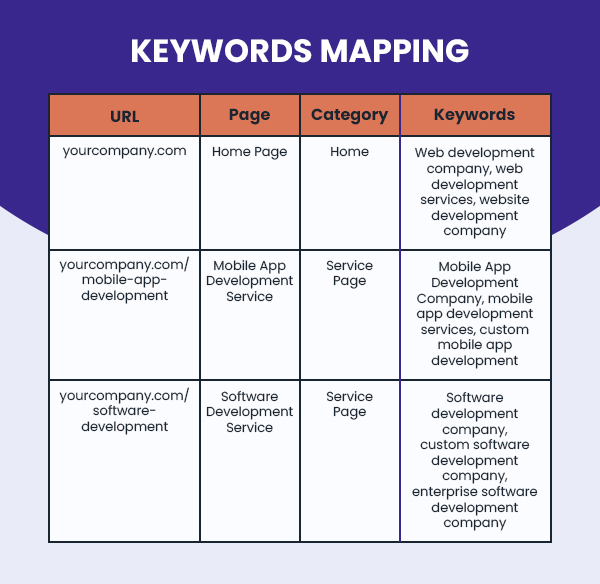
These two are the most widely used concepts in SEO for managing and optimizing content on search engines. Keyword mapping is the process of assigning keywords to topics or specific elements on each page of your website.
The main purpose of keyword mapping is to target a set of keywords that naturally fit the content.
Example of a Web Development Company
to Understand Keyword Mapping
Silos is a method of structuring website content based on the theme of your keywords. The logical hierarchy is created for seamless navigation and understanding of content. Silos are generally focused on the broader theme with more subtopics.
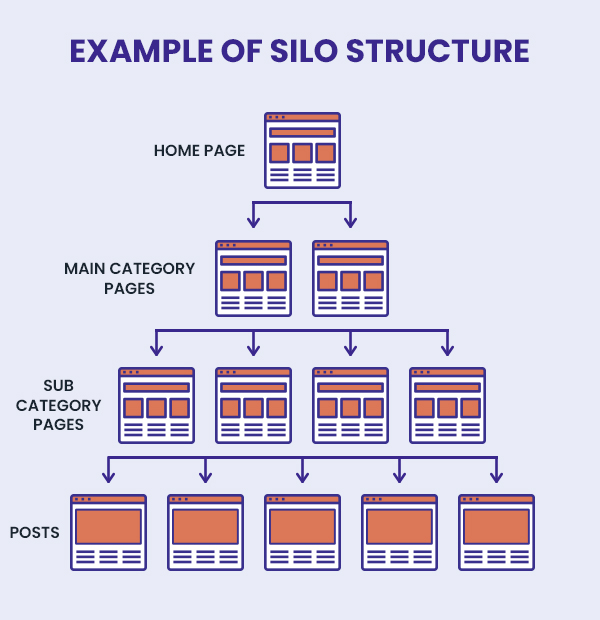
Leveraging these strategies are important for ranking on SERPs and optimizing website content. You can also improve the relevancy and make the content more coherent.
Also Read: Website Development Checklist To Help Create Your First Website
A Golden Rule Of SEO
While we have discussed the importance of keywords in content, we have also mentioned that there is no fixed number for determining keyword density. Focusing solely on the density of the keywords won’t help you achieve the desired result.
Prudent & natural use of keywords and drafting quality, unique, & relevant content that engages readers and solves the users’ queries is a sure-shot way to grow on SEO.
Google Now Prioritizes:
Search engines have evolved far beyond simple keyword matching. Today, Google focuses on delivering content that is reliable, helpful, and created by people who genuinely understand the topic. This shift is reflected in four key principles. Together, they define the quality of content that ranks well.
Experience
Google values content that reflects real, first-hand experience. This means going beyond generic information and sharing insights based on actual use, testing, or involvement.
For example, a blog about web hosting becomes more valuable when it includes personal observations, real performance comparisons, or practical challenges faced while using a service.
Expertise
Expertise refers to the depth of knowledge shown in the content. Google looks for content that is accurate, well-informed, and clearly written by someone who understands the subject.
This does not always mean formal qualifications, but it does require clarity, correctness, and useful insights. Well-structured explanations, detailed guides, and clear problem-solving approaches help establish expertise.
Authoritativeness
Authoritativeness is about credibility. It reflects how well a website or content creator is recognized within a particular niche or industry. Websites that consistently publish high-quality content and are referenced by others tend to build stronger authority over time.
Signals such as backlinks, mentions, and consistent topic coverage contribute to this. When your content becomes a reliable source of information, it naturally gains authority in the eyes of both users and search engines.
Trustworthiness
It’s the most critical factor. Users need to feel confident that the information they are reading is accurate and safe to rely on. Google evaluates trust through various signals such as secure websites, transparent information, and honest content.
Clear contact details, privacy policies, accurate claims, and well-maintained pages all contribute to trustworthiness. Content that avoids exaggeration and provides balanced, factual information tends to perform better in the long run.
How Does It Affect Keyword Strategy?
As Google’s focus shifts toward quality and credibility, keyword strategy must also evolve. It is no longer enough to simply target high-volume keywords. The way content is created around those keywords plays an equally important role.
Add Author Bios
Including author bios helps establish both expertise and trust. When readers know who created the content, it adds a layer of credibility. A short bio highlighting experience, background, or area of specialization can make the content more reliable and relatable. It also signals to search engines that the content is created by a real person with relevant knowledge.
Include Case Studies
Case studies are a powerful way to demonstrate real-world experience. They show how a concept works in practice and provide measurable results. Whether it is a performance improvement, SEO growth, or business outcome, case studies add depth to your content. They also make your content more engaging and useful, as readers can see practical applications rather than just theory.
Use Real Examples
Real examples make complex ideas easier to understand. Instead of explaining concepts in abstract terms, examples provide clarity and context. This improves readability and helps users connect with the content. Using examples also reinforces expertise and experience, making the content more valuable for both users and search engines.
Build Topical Authority Instead Of Thin Pages
Instead of creating multiple shallow pages targeting individual keywords, focus on building comprehensive content around a topic. Covering a subject in depth helps establish authority and improves your chances of ranking for multiple related queries.
Topical authority is built over time by consistently publishing well-researched, detailed content that answers a wide range of user questions within a niche. This approach not only improves SEO performance but also creates a stronger, more trusted online presence.
Also Read: Does My Website Need a Blog – A Detailed Overview
To Sum Up
SEO is a tricky strategy in digital marketing; when used wisely, it can deliver enormous results, but a single wrong step can render all your hard work in vain.
We suggest you follow SEO best practices, target the right keywords, craft compelling content, and don’t forget to track your growth. Keeping an eye on the nitty-gritty of SEO will certainly help you thrive in the SERPs.
FAQs
Place keywords naturally in key areas: your page title, headings, intro paragraph, image alt text, and meta descriptions.
For example, if your primary keyword is “home workout tips,” ensure it appears in the title, headings, and a few times in the content body.
Yes! Keyword stuffing can confuse readers and harm SEO. Google favors natural, well-written content, so focus on relevant keywords that add value to the topic.
Use tools like Google Keyword Planner or Ahrefs. Your primary keywords should be your main focus, while secondary keywords should support it.
For example, if “summer fitness tips” is primary, “home workout” could be secondary.
A primary keyword provides focus, helping your content rank better for a specific search. Think of it as the main theme, making it easier for search engines to categorize your content.
Secondary keywords broaden your reach and answer related questions.
For example, if “web hosting for beginners” is primary, secondary keywords like “affordable web hosting” improve relevance and search potential.
A balanced approach is key. Aim for a primary keyword in each major section and a few related keywords where relevant. Always prioritize readability.
Yes! Targeted keywords attract the right audience and increase visibility. Focusing on a keyword or phrase ensures your content reaches people actively searching for that topic.